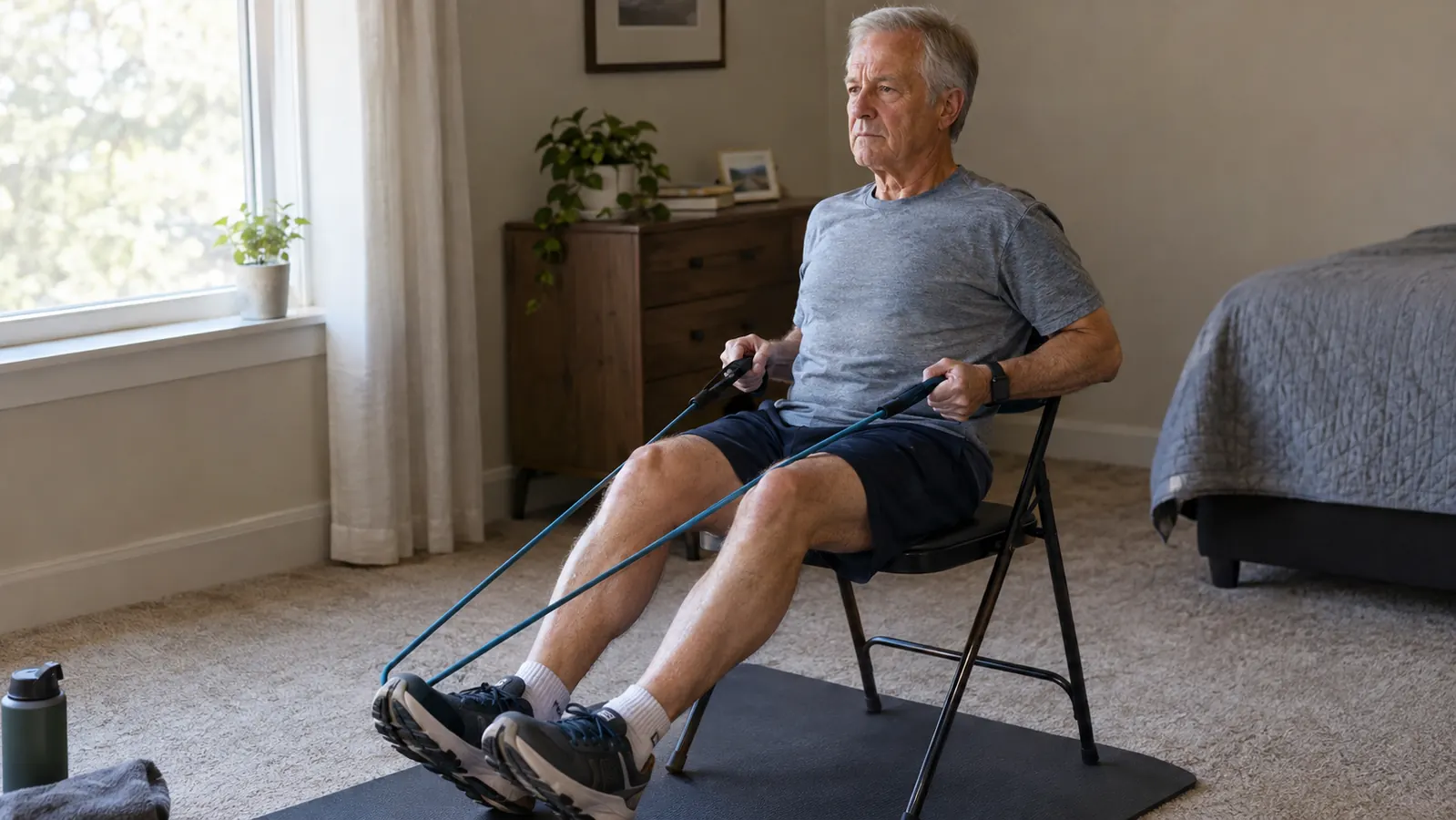
Here's what I wish someone had told me before I ordered my first set of resistance bands with handles: the hard part of the exercise isn't the pull. It's the last few inches, the part where the band is stretched the tightest. I'm Gene Holloway, I'm 69, and I've been training in the spare bedroom of our house in Enid, Oklahoma for about three years now. The WHATAFIT resistance band set showed up last August, and it has been on the floor of that room, in regular rotation, ever since. Fourteen months is long enough to learn what a product does well and what it would rather you not notice.
My doctor told me, that same winter I slipped on an icy porch step and went down hard, that losing leg strength was the thing most likely to take my independence. That got my attention more than any fitness magazine ever did. I started with bodyweight moves and a rack of old garage-sale dumbbells, and I added the bands later, when I wanted something that would work my back and shoulders without loading my knees. This is the honest version of that story: what surprised me, what annoyed me, and what I'd tell a friend my age before he clicked buy.
The Quick Verdict
A well-made, easy-to-start band set that has earned its place in my weekly routine. Not perfect, and I'll tell you exactly where it falls short.
Amazon Check Today's Price →The set I've reached for every week for fourteen months
If you're over 60, training at home, and tired of advice that assumes you can lift like a twenty-year-old, this is the honest breakdown of the WHATAFIT bands, including the parts the listing photos leave out.
Amazon Check Today's Price on Amazon →How I've Used It
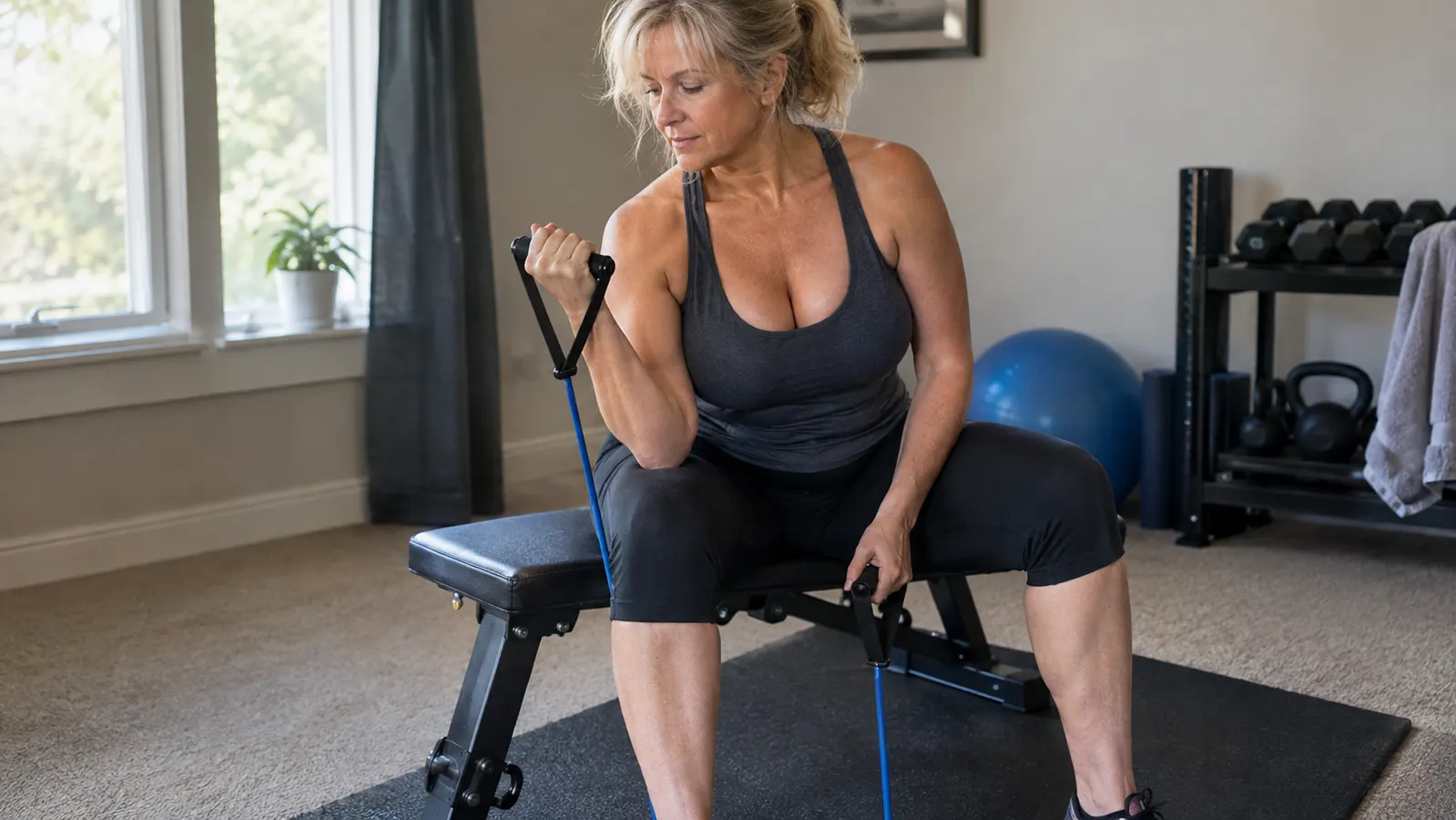
Most mornings I roll out the rubber mat, pull the bands from the drawstring bag they came in, and run through about thirty minutes of work. The set comes with five bands of different resistance, two foam handles, a door anchor, and a pair of ankle straps. I use the two lightest bands for shoulder work and the middle ones for rows and chest press. The heaviest band I've used maybe a dozen times, mostly for leg work where I stand on the middle of the band and do squats or kickbacks. When I want to vary it, I use the folding weight bench I picked up about a year ago for chest presses, setting the back to a slight incline so the band pulls across rather than straight down.
My left knee has mild osteoarthritis, and it lets me know when I've overdone it. The bands let me start a movement in the easy range and build tension as I go, so the joint gets warmed up before it gets loaded. That's the part I didn't expect. With dumbbells, the weight is the weight from the first inch. With a band, you ease into it. For a stiff knee, that's a real advantage, not a marketing line.
Carol, my wife, uses them a couple of times a week too, usually for seated rows while she watches something on her tablet. That's another thing I didn't plan on: a piece of equipment both of us actually use. The bands live in their drawstring bag behind the door, they take up about as much room as a loaf of bread, and they don't make noise. In a carpeted spare bedroom, that matters more than you'd think.
What Nobody Tells You About Band Resistance
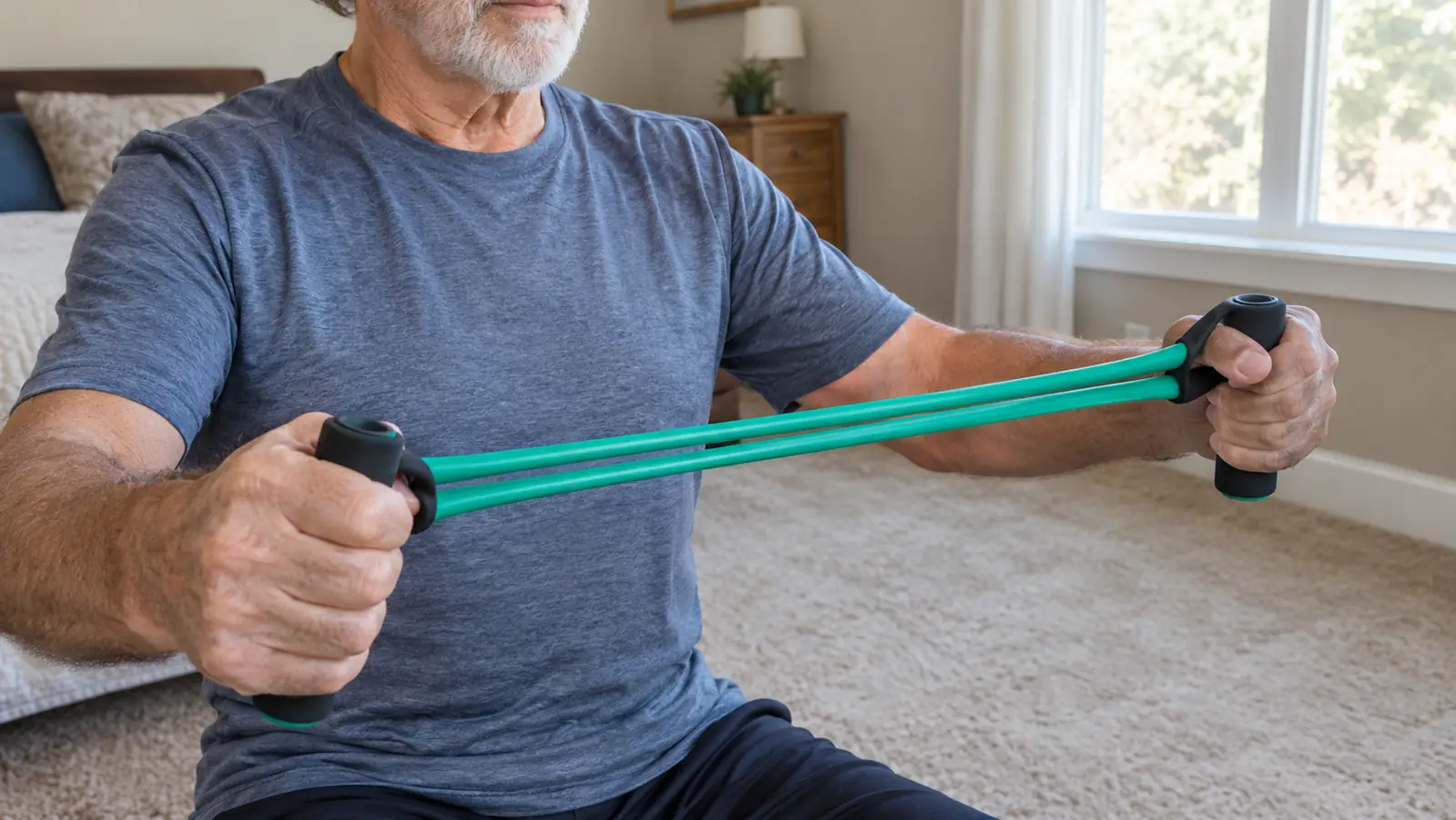
Here's the thing the product photos don't show. A band doesn't give you the same resistance through the whole movement the way a dumbbell does. It's light when it's slack and heavy when it's stretched. So a bicep curl with a band is hardest at the top, and a chest press is hardest at the start, when your arms are fully extended and the band is stretched the most. The first time I did a chest press with the door anchor, I nearly floated the first rep and then fought the last two inches like they were made of concrete. The same thing makes the bands forgiving for a beginner, because the easy part of the movement is where you're still figuring out your form.
That takes getting used to, and it changes how you count. With a dumbbell, a rep is a rep. With a band, the last few inches are the whole workout, and the first few are almost wasted. The fix is simple: pick a band where the hardest part of the movement is still doable, and don't count the easy part as progress. Once I figured that out, the bands made more sense than any of the reviews I'd read.
The Door Anchor Is the Weak Link
The door anchor is the piece I'd warn anyone about. It's a strap with a loop that you close a door on, and it works, mostly. But it only works if the door closes snug against the strap, if you anchor it on the hinge side, and if you check it before every set. I've had it slip mid-rep twice. Nothing broke, and I didn't get hurt, but a band that slips while you're pulling hard snaps back fast, and that's how people get a welt on the forearm. I also learned to anchor only in the solid bedroom door, not the hollow closet door, because the strap can leave a crease on the edge over time.
The fix I settled on: I anchor it in the bedroom door, close the door firmly, and give the strap a tug before I start. For moves where the anchor has to be low, like a chest press, I close the door and then wedge a folded washcloth under it so it can't rattle. That's the kind of detail nobody puts in the listing, and it's the difference between a tool you trust and one you're nervous around.
Fourteen Months In: What Wears, What Doesn't
After fourteen months of regular use, the WHATAFIT bands still stretch and snap back like they did the first week. I check them every couple of months for nicks or rough spots, the way you'd check a garden hose before the season starts. The foam handles are still firm, the ankle straps still close tight, and the drawstring bag has held up. I don't stretch any band past about double its relaxed length, and I never leave one lying in the sun, which out here in Oklahoma is a real risk.
The progress is harder to measure than it was with dumbbells, and that's worth saying out loud. With a set of dumbbells, you know exactly how much you lifted last month. With bands, you just know the middle band got easier and the heavy one stopped feeling like a mistake. My left knee doesn't decide my day the way it used to, and I can get up off the floor without using the chair arm. I measure progress in small things: carrying a case of canned goods up the porch steps without thinking about it, getting out of the car on a long drive without bracing both hands on the door frame. I credit the bands for a fair share of that, but I'd credit the routine just as much. The tool only works if you show up.
The Exercises That Stuck
If you're wondering what a 69-year-old actually does with these things, here's the routine that stuck. Seated rows: I sit on the folding chair, loop the band under my feet, and pull the handles to my waist, squeezing my shoulder blades. Chest press: door anchor at chest height, push straight out, and fight the last few inches. I set the back of the folding bench to a slight incline for that one, so the pull comes across my chest instead of straight down. Standing kickbacks for the back of the arm, which is the part that helps you push yourself up out of a chair. And for the legs, the move I value most: I sit on the chair, hook the band under my foot, and straighten my knee against the resistance. That one move, three sets of twelve, most mornings, is the closest thing I have to a guarantee against the weakness my doctor warned me about.
The ankle straps come with the set, and I use them for one thing: standing leg lifts to the side, holding the back of the chair for balance. That works the hip, which is the muscle that keeps you from tipping over when you catch a toe on a curb. My balance isn't what it was at fifty, but it's better than it was at sixty-six, and I can point to the day I started doing those lifts as the day it started improving.
Fourteen months in, the WHATAFIT bands still stretch like the day they arrived. The part that's harder to measure, but just as real, is that my left knee no longer decides what kind of day I'm going to have.
Where Bands Beat the Gym, and Where They Don't
For a man my age, training at home, the bands win on almost every practical point. They're quiet. They store flat. They cost a fraction of a gym membership, and the current price is easy enough to check. They let me start light and add resistance in small steps, which matters when your joints complain. And they're gentle enough that Carol, who has never liked gyms, will sit down and do a set of rows without being talked into it. There's also no commute. On a cold Oklahoma morning, the walk from the kitchen to the spare bedroom is the whole trip, and that's a feature, not a weakness.
But I'd be lying if I said they replace everything. The heaviest band still won't challenge a strong thirty-year-old for long. The tension curve means some movements feel awkward until you learn them. And on carpet, standing on the middle of a band for a squat means the band can bunch up under your foot, which is annoying and a little unsafe. I do most of my band work from a chair or from the floor, and I use my dumbbells for the moves where a fixed weight just makes more sense.
What I Liked
- Gentle on stiff joints; you ease into the resistance instead of meeting it at full weight
- Five bands mean small steps of progression, which suits a 69-year-old better than big jumps
- Quiet, compact, and easy to set up in a spare bedroom
- Comfortable foam handles and straps that have held up for fourteen months
- Simple enough that my wife actually uses them too
Where It Falls Short
- The door anchor can slip if the door doesn't close snug; check it every set
- Resistance is hardest at the stretch, which takes getting used to
- The heaviest band has a ceiling for younger or stronger users
- Standing on the band for squats on carpet is awkward
- The printed workout guide is basic; you'll want a physical therapist's advice
Who This Is For
If you're in your sixties or seventies, and you've been told to lift weights, but the idea of a gym membership or a rack of iron in the house sounds like more trouble than it's worth, this set is a sensible place to start. It's for the person who wants to keep their legs strong enough to get out of a chair, their balance good enough to handle a patch of ice, and their routine simple enough to actually keep. It's for people who, like me, would rather do thirty quiet minutes in a spare bedroom than drive anywhere. Nobody here is promising you a transformation you can buy. This is just the tool that worked for me, and the work is the part you have to bring.
Who Should Skip It
If you're already lifting heavy and you're looking for something that will push you the way a loaded barbell does, skip it. If you have a shoulder or elbow condition that makes pulling motions painful, talk to a physical therapist before you buy, because bands put real tension on the joints at the end of the range. And if you're the kind of person who will use something twice and let it gather dust, save your money. The bands are a tool, not a result. I'm not a doctor, and I'm not your trainer. I'm a retired mail carrier who got scared straight by his doctor and found something that worked. If you're shopping for a gift for someone my age, don't buy it without asking first. The routine has to be their choice, or it won't survive February.
If a friend from the mail route called me up and said he was thinking about bands, here's what I'd tell him. Start with the lightest band and don't be embarrassed about it. The point isn't to impress anyone, it's to build a habit your joints will tolerate. Do the movements slowly, especially the return part, because that's where the muscle actually works. And keep a simple log, a spiral notebook is fine, so you can see that the middle band got easier instead of guessing.
And I'd tell him to check with his doctor or a physical therapist first, because I'm neither. My doctor gave me the push I needed, and a physical therapist I saw once after the fall gave me the two exercises that matter most. The bands are the tool. The advice is the map. You want both, and you want the map drawn by someone who knows your knees, not by a listing page.
Would I buy them again? Yes, and I'd buy the same set. Not because it's perfect, it isn't. Because it's the tool that got me from scared and stiff to consistent, and fourteen months later it's still doing the job. If you're my age and you've been putting this off, that's the honest review: the bands work, the routine matters more, and the best day to start was last year. The second best day is today.
The honest bottom line: these bands earned their spot in my routine
Fourteen months of use, one stiff knee, and a spare bedroom gym. If that sounds like your situation, the WHATAFIT set is worth a look at today's price.
Amazon Check Today's Price on Amazon →