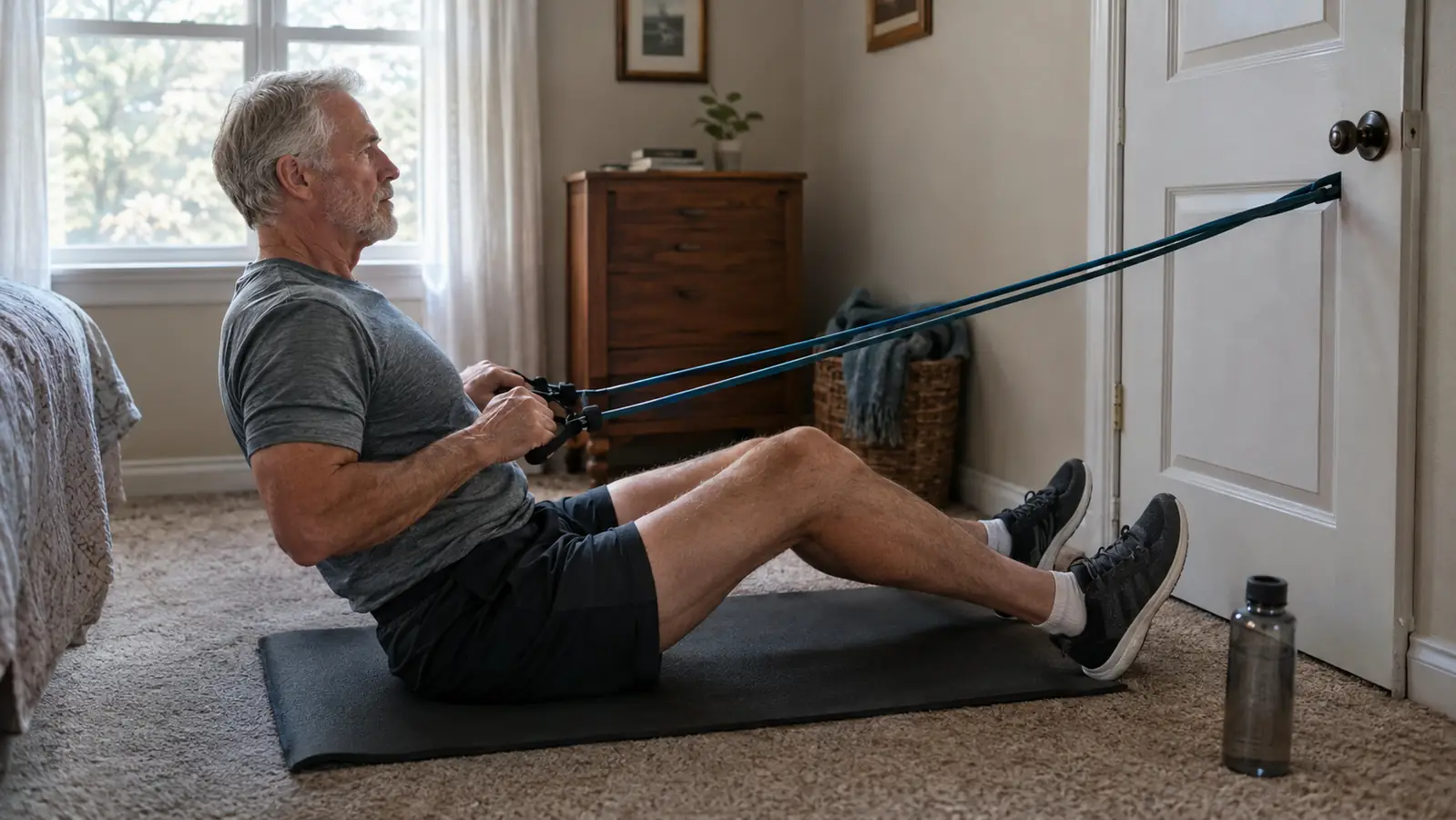
This is the question I get asked most often by men my age: are resistance bands actually enough, or do I need to buy a set of dumbbells? I'm Gene Holloway, 69, a retired rural mail carrier in Enid, Oklahoma. Three winters ago I slipped on an icy porch step, and my doctor told me the thing most likely to take my independence was losing leg strength. So I set up a small gym in our spare bedroom, about 11 by 12 feet, carpeted, with a rubber mat over part of the floor. I added a set of WHATAFIT resistance bands with handles. Fourteen months later I still reach for them most days, and these days I also own a set of adjustable dumbbells. Here is the plain-spoken version of what I learned: one is not better than the other. They do different jobs, and for an adult over 60 training at home, the bands are the better place to start.
If you only want one tool and you want it to cover the most ground with the least risk, buy the bands. If you want to get as strong as your body will allow over the next ten years, you will eventually want both. That sounds like a hedge, but it is the honest answer, and I would rather give you an honest answer than a tidy one. Here is the short version of the comparison, then the details.
How I Compared Them
I am not a doctor and I am not a trainer. I am a former mail carrier with a stiff left knee, mild osteoarthritis in that knee, and a lower back that complains if I sit too long. My wife Carol, 67, trains alongside me sometimes, and she has her own opinions about which tool feels better. I started training at home at 66, so everything I say here comes from the last three years of actually doing the work on a carpeted bedroom floor, not from a gym floor or a textbook.
For this comparison I used the WHATAFIT set for most of my upper body work and for squats, rows, and shoulder presses. For the free weight side, I used the fixed garage-sale dumbbells I had at the time, in the weights I could actually handle, from 5 pounds up to 25. I kept the same exercises, the same rep counts, and the same rest times, then wrote down what hurt, what felt smooth, and what I actually wanted to do the next day. That last part matters more than people admit. The best exercise tool is the one you will still use in March.
I also paid attention to the things that do not show up in a table. How long did setup take? Did I dread the session? Did my knee complain the next morning? Did Carol want to join in? Those small signals predict whether a tool gets used, and a tool that does not get used is worth exactly nothing, no matter how good the reviews are.
One more thing about the way I compared them. I did not test the bands at their easiest and the dumbbells at their hardest, because that would have been rigged. I tested both at the level a 69 year old with a stiff knee can actually manage, which is the level that matters for the person this article is for.
| WHATAFIT Resistance Bands | Fixed Dumbbells | |
|---|---|---|
| Cost to get started | One set covers every major move, no rack or bench required | A useful range of weights costs several times more, plus a rack or bench |
| Space needed | Five bands and handles fit in a nightstand drawer | A full set needs a rack or a dedicated corner |
| Joint impact | Load builds gradually through the range, easy on a stiff knee | Heavy weights load joints hard at the bottom of a lift |
| Progressive overload | Stepping up band resistance is a bigger, less precise jump | Add 5 pounds at a time and track it exactly |
| Top end load | Bands top out well below what a strong lifter can push | Dumbbells go as heavy as you need, for years |
| Durability | Bands lose tension over time and eventually need replacing | A good dumbbell outlasts its owner |
| Safety at home | Nothing to drop on your foot, nothing to fall off a rack | Heavy iron on carpet is a real hazard if your grip goes |
| Best for | Daily full-body work, travel, small rooms | Heavy progressive strength training |
Where WHATAFIT Resistance Bands Win
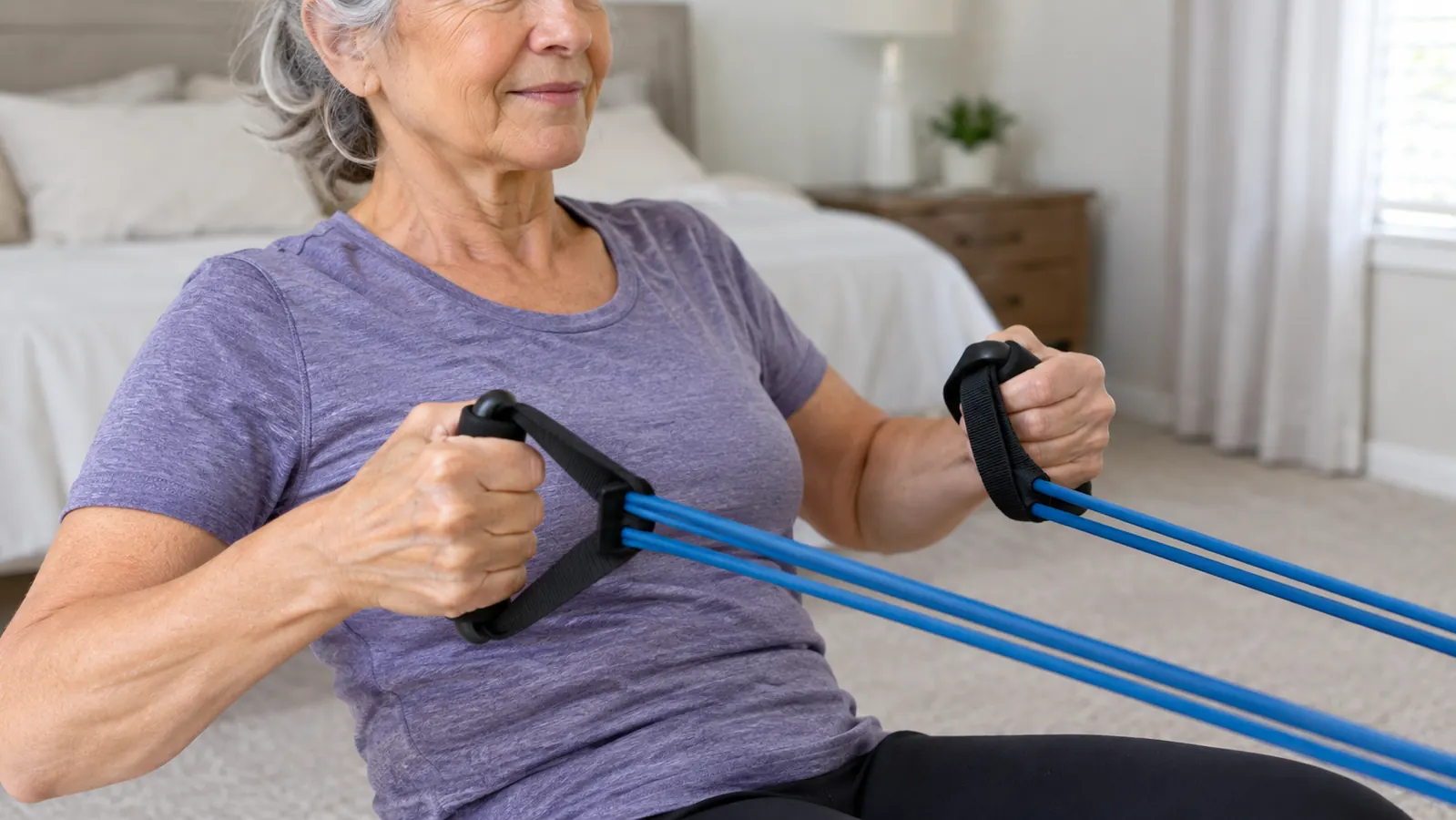
The first thing you notice with the bands is how little they ask of you. The whole set, five bands plus handles and a door anchor, fits in a nightstand drawer. I can set up in the spare bedroom in under a minute, do a full session, and put everything away before Carol finishes making coffee. With dumbbells, I need the weights out, a clear spot on the mat, and a plan for where the heavier ones live between sessions. In an 11 by 12 foot room with carpet, that difference is real.
The second thing is the joint impact. My left knee has mild osteoarthritis, and the bottom of a dumbbell squat is exactly where that knee lets me know it exists. Bands change the feel entirely. The resistance builds gradually as the band stretches, so the hardest part of the movement is at the top, where my knee is happiest, and the bottom is light. I can do band squats, band rows, and band presses without that grinding warning in the joint. For a man with a stiff knee, that is the difference between training three times a week and training once.
There is also the safety angle, and I do not say this lightly. A dropped dumbbell on a carpeted floor is a hazard. If my grip goes on a 25 pound weight at the top of a press, that weight is coming down, and my foot is in the way. Bands have their own risks, mostly from a band snapping or slipping, but the failure mode is a lot less dramatic. Nothing heavy ever falls on me in this room.
Where Free Weights Win
I have to be straight with you about the places dumbbells are better, because pretending otherwise would be a disservice. The first is progressive overload. Bands increase resistance in steps that are hard to measure. I switch from the medium band to the heavy band and the jump feels like a lot, but I cannot tell you exactly how many pounds I just added. With dumbbells, I move from 15 to 20 pounds and I know precisely what I did. For a man who likes tracking progress, that clarity is worth something.
The second is the top end. Bands top out. Once I got comfortable with the heaviest band in the WHATAFIT set, I could not make the movement meaningfully harder without buying a stronger band or doubling up. Dumbbells keep going. The 25s felt heavy back then, but within a year I was pressing 30s, and the tool never got in the way of that. Durability is the third honest point. A good dumbbell will outlive me. Bands lose tension over time, and even with careful storage, I expect to replace mine every couple of years. That is a real cost, even if it is a small one.
There is one more thing dumbbells do that bands cannot: they teach you to handle a real load through a full range of motion. Picking a 20 pound weight off the floor, pressing it overhead, and lowering it slowly uses your whole body in a way that a band anchored to a door does not. That carries over to real life, to carrying groceries and lifting a heavy suitcase onto a high shelf. I do not want to pretend that transfer does not exist.
Fourteen months in, my knee complains less on stairs than it did when I was 66. That is the only result that matters to me.
Start With the Bands, Not the Iron
The WHATAFIT set covers squats, rows, presses, and pulls in a spare bedroom, with nothing heavy to drop on your foot. It is the tool I reach for most days, and the one I would buy first if I were starting over at 66. Check today's price on Amazon and see if it fits your budget.
Amazon Check Today's Price on Amazon →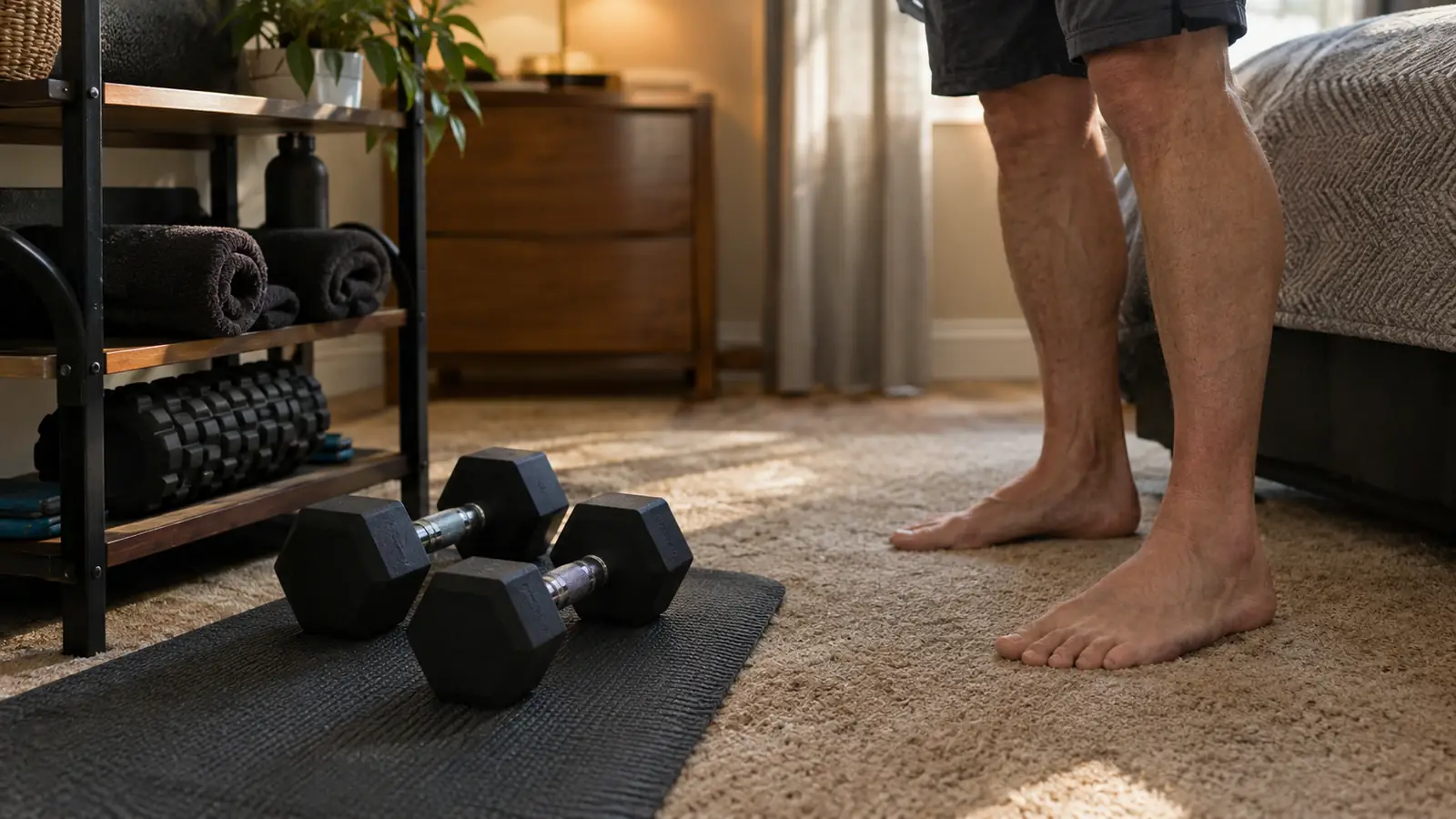
What a Week Looks Like at 69
In case you are wondering what this actually looks like in practice, here is a typical week. Monday is legs: band squats, band hip hinges, and standing band kicks to the side for balance. Wednesday is upper body: band rows, band presses, and band pull-aparts. Friday is a shorter full-body session with the lightest band, mostly to keep the joints moving. Every session is about 25 minutes, and none of them require me to move furniture or clear the floor. That ease is the whole point.
Carol does the same sessions two or three times a week with the lightest band, and she prefers them to the dumbbells for the same reason I do: nothing feels like it is grinding. Back then the dumbbells came out maybe once a week for a heavier set of rows or presses, and that was enough to keep them honest. The bands are the daily driver. The dumbbells are the occasional heavy tool, and they earn their keep when they come out.
The pattern that emerged after fourteen months is simple. Bands build the habit because they are easy to start. Dumbbells add the load once the habit exists. Most people I know over 60 quit the gym because the habit never formed, not because the weights were too light. The bands solve the problem that actually kills home training, and they solve it on day one.
Who Should Buy Which
Buy the WHATAFIT bands first if you are over 60, starting from scratch, short on space, or dealing with angry joints. I wish I had started that way at 66. The bands let me build leg strength and balance with almost no barrier to starting, and they are forgiving while the movement patterns are still new. Buy dumbbells instead if you already have a solid base, you have the space and the budget, and your joints tolerate heavy loading. Buy both, in that order, if you are serious about this being a ten year project. That is the order I would do it in again, and the order I recommend to anyone who asks.
One more thing worth saying: your situation may be different from mine. If you have a joint replacement, a heart condition, or any balance concerns that go beyond a stiff knee, talk to your doctor or a physical therapist before you buy anything. I say this in every article I write because it is the truth. A tool is only as good as the body it is attached to, and nobody knows your body like you and your physician do.
One practical note on buying. The WHATAFIT set includes five bands of different resistances, and that range matters more than you might think. The lightest band is where you start, the heaviest is where you graduate to, and the middle three cover everything in between. A single band, no matter how good, will not do that. The set also has more than 36,000 ratings on Amazon and a 4.6 star average, which matches my own experience after fourteen months.
The Bottom Line
If I had to give one sentence of advice to a 66 year old version of myself, it would be this: buy the WHATAFIT bands today, start with the lightest band tomorrow, and do not worry about dumbbells until the bands feel easy. By then you will know whether you want the heavier path, and you will have the strength and balance to walk it safely.
The bands are not a compromise. They are the right tool for the job most days of the week, and the job is keeping your legs strong enough that an icy porch step stays a nuisance and not a turning point. That is the only measure that matters to me.
I will also say this: the day I stopped comparing the two and just used both for what they are good at was the day my training got better. Comparison is useful for a decision. Once the decision is made, the tools are just tools. Use them.
See Today's Price on the WHATAFIT Set
Five bands, handles, a door anchor, and a carrying bag. That is everything you need to start training at home, and it takes up less room than a pair of shoes. Get the set at today's Amazon price and start with the lightest band tomorrow morning.
Amazon Check Today's Price on Amazon →