
My doctor didn't beat around the bush. At my checkup a few years back, he told me the thing most likely to take my independence wasn't my heart or my blood pressure. It was leg strength. Lose that, he said, and stairs get hard, getting out of a chair gets hard, and a fall becomes a much bigger problem than it used to be. I already knew something about that. Three winters ago I went down on an icy porch step in Enid, Oklahoma. No broken bones, thank goodness, but it scared me straight.
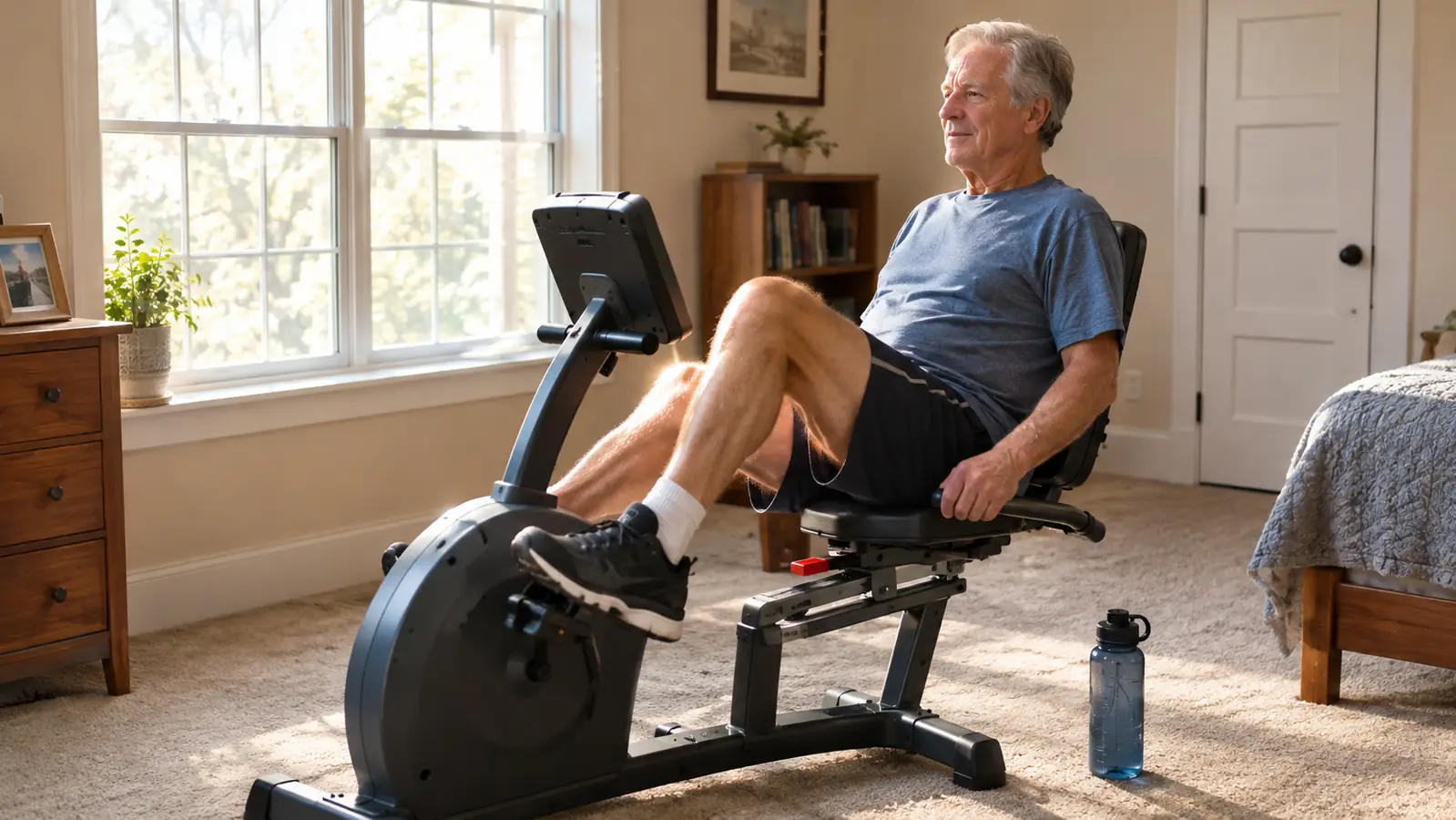
That's what pushed me into setting up a small gym in our spare bedroom. The room is about 11 by 12 feet, carpeted, with a rubber mat over part of the floor. Not a garage, not a basement. I'm 69, a retired rural mail carrier with 31 years on the route, and I've got a stiff left knee with mild osteoarthritis and a lower back that complains if I sit too long. So when I went looking for a machine I could use every day without making either one worse, I landed on the Sunny Health & Fitness Smart Recumbent Bike. Months of daily use later, here's what I think of it.
The Quick Verdict
A comfortable, dependable recumbent bike that does exactly what I need: builds leg strength without punishing my knee or my back. Not flashy, but I've used it nearly every day for months and it has held up.
Amazon Check Today's Price →The bike that got me pedaling again
After months of daily use, the Sunny Health & Fitness Smart Recumbent Bike is still the first machine I head to in the morning. Wide cushioned seat, solid back support, and a smooth ride that never aggravates my stiff knee.
Amazon Check Today's Price on Amazon →How I've Used It
I've had the Sunny Health & Fitness Smart Recumbent Bike set up in the spare bedroom since the start of the year. My routine is boring on purpose. Four or five mornings a week, I do 20 to 30 minutes before breakfast. I keep the resistance somewhere in the middle of the range, and I pedal at a pace where I can still carry on a conversation. That's the pace my physical therapist suggested when I told her about this plan, and it has worked out well.
The wide cushioned seat and the backrest matter more than I expected. On an upright bike, I always ended up leaning on my hands, and my lower back would start to ache within ten minutes. Here I sit back, my spine stays supported, and my left knee moves through a range that doesn't bother it. On mornings when that knee is stiff and cranky, a slow ten minutes on this bike loosens it up better than sitting in a chair ever did.
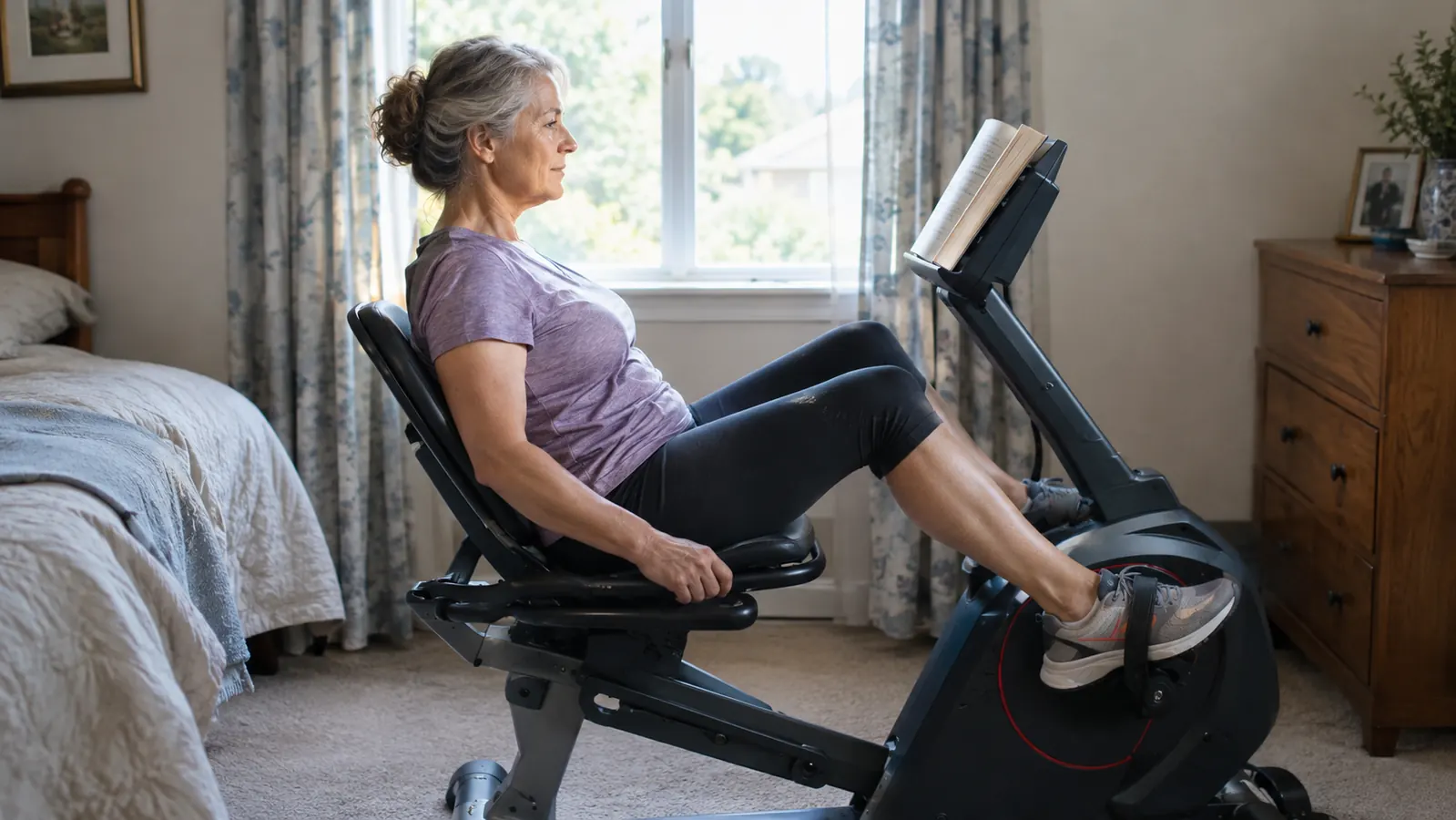
Carol uses it too, a couple of times a week, usually with a paperback propped on the console. She's 67 and has no interest in a gym membership. The seat slides forward and back easily enough that we can both use it without a fight, and that's more than I can say for some equipment we've owned over the years.
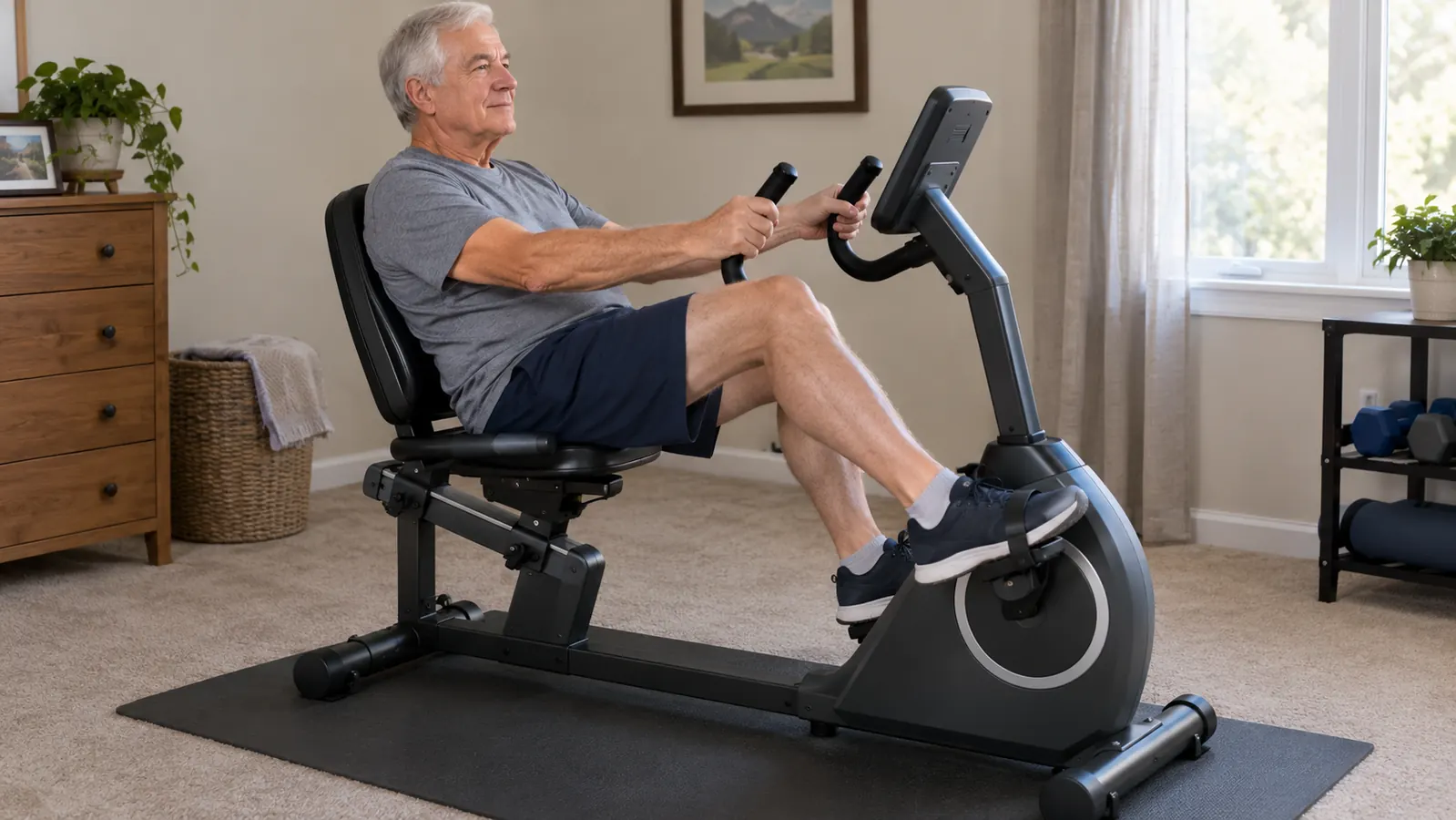
I keep the bike on the rubber mat that covers part of the carpet. That keeps the carpet from wearing and keeps the bike from sliding even when I push hard. The mat didn't cost much at the hardware store, and I'd call it a worthwhile addition. The bike has small wheels on the front, so I can tip it and roll it when I need to vacuum underneath, though honestly I mostly leave it where it is.
Why a Recumbent Bike Made Sense for a Man With a Cranky Knee
I'll be plain about this: I did not want a treadmill. A treadmill is hard on the joints, and the thought of my stiff knee landing on a moving belt did not appeal. An upright exercise bike was closer, but most of them put my weight on my hands and made my back complain. A recumbent bike puts you in a chair with your legs out in front of you. The seat takes your weight, the backrest holds you up, and your knee works through a gentler arc.
For someone whose doctor put leg strength at the top of the list, that geometry matters. I can push the pedals hard when I feel good and back off when I don't, without ever feeling like I'm going to lose my balance. That last part is not a small thing when you've had a fall on the ice and you know how fast things can change. Being able to get on and off the bike without holding onto a wall was one of my requirements, and this machine passes that test easily.
My doctor didn't tell me to buy any particular machine. He told me to move more and to make my legs work against some resistance, and he suggested I check with a physical therapist about the best way to do that with my knee. I did, and she's the one who pointed me toward a recumbent bike in the first place.
The Seat, the Backrest, and the Ride
The wide cushioned seat is the reason I picked this model over a couple of cheaper ones, and I don't regret it. I'm not a small man, and I've sat on exercise bike seats that felt like a fence rail. This one has enough padding that a 30-minute ride doesn't leave me sore, and the backrest means I'm not holding myself up with my arms. For a man with a lower back that complains, that support is the whole ballgame.
The ride itself is smooth. The pedals turn easily, the resistance adjusts in steady steps, and there's no wobble in the frame even when I push hard. The belt drive keeps things quiet, which matters in a house where Carol is often reading in the next room. I can hear the television over the bike, and she can hear me over it, and neither of us has to shout.
Getting on and off is easier than I feared. The seat sits low, so I can lower myself onto it the way I'd sit in a chair, and the handlebars give me something to hold while I get settled. There's no swinging a leg over a top tube like on an upright bike. For a man who thinks about falls the way I do, that's a real comfort.
One honest note: the console is not a medical device. It tracks time, distance, speed, and calories, and I use those numbers the way I use a kitchen timer, as a rough guide. The heart rate sensors on the handlebars give a ballpark reading, but if you have real heart concerns, talk to your doctor and wear a proper monitor. I'm not a doctor, and I don't want anyone treating my experience as medical advice.
The Smart Features: What I Actually Use and What I Ignore
This model is the smart version, which means it connects to an app on your phone. I'll be honest: I'm not a gadget person. I'm a retired mail carrier, not a tech reviewer. But I've found the app useful in one specific way. It keeps a history of my rides, and seeing the week laid out in front of me keeps me honest. On days when I'd rather skip, it's harder to tell myself I've been consistent when the record says otherwise.
What I ignore: the social features, the leaderboards, and anything that wants me to compete with strangers. I'm not training for anything. I'm pedaling so I can keep getting out of a chair without using my hands, and so I can carry a box of groceries up the porch steps without thinking twice. The app can do its tricks. I just want the record.
If you'd rather not deal with an app at all, the bike works perfectly fine without it. The console runs on its own, and you don't have to pair anything to ride. That was important to me. I didn't want a machine that held my workout hostage to a phone, and this one doesn't.
One small thing I appreciate: the console is easy to read without my reading glasses. The numbers are large and the display is bright enough in a room with normal lighting. That sounds like a small detail, but at my age, small details are the difference between a machine I use and a machine I trip over.
What Wears, What Holds Up, and What Needs a Wrench
I put the bike together myself in about an hour, with a wrench and a screwdriver from my toolbox. The instructions were clear enough for a man who has assembled a lot of things in 69 years. There were a few moments where I had to look twice at the diagrams, but nothing required a second pair of hands, and Carol was glad I didn't ask her to hold anything.
After months of daily use, the frame is solid, the seat shows no signs of wearing thin, and the resistance still clicks through the same steady steps it did on day one. I've tightened the pedals once and wiped the frame down with a damp cloth regularly, and that's the whole maintenance list. No squeaks, no wobbles, no parts that feel loose.
The pedals have straps that I can loosen or tighten, and I keep them loose enough to slip my feet out quickly. I read that advice somewhere, and it made sense to me. You don't want your feet locked in if you need to stop in a hurry.
The only thing I'd warn you about is the size. It's a full-size machine, and it needs a spot where you can get on and off from the side. Our spare bedroom is 11 by 12 feet, and with the bike against one wall there's plenty of room. But if you're picturing something you can fold up and slide under the bed, this is not that. Measure your space before you order.
What Else I Tried Before This One
Before I bought this bike, I tried a few other things, and I think that's worth sharing. I borrowed a friend's upright stationary bike for a week, and my lower back let me know about it by day three. I also bought one of those small under-desk pedal exercisers, thinking I could use it while I watched television. It was fine for moving my legs, but it didn't give me the resistance I needed to actually build strength, and I stopped using it after about six weeks.
That experience taught me something: for a man my age, the machine I'd actually use was the one that was comfortable enough to sit on for 30 minutes. The recumbent position solved the comfort problem, and the resistance range on this bike solved the strength problem. I don't need a gym full of equipment. I need one machine I'll get on every day, and this is the one.
The other thing I tried was walking more, and I still do that. But Oklahoma summers get hot, and on days when the heat or the ice kept me inside, I had no good option. The bike filled that gap, and it turned out to be the option I actually stuck with. There's something about having it right there in the spare bedroom that makes the habit stick.
What I Liked
- Wide cushioned seat and backrest make 30-minute rides genuinely comfortable
- Smooth, quiet belt drive that doesn't disturb the rest of the house
- Easy to get on and off, which matters more as you get older
- Resistance range is plenty for daily fitness work
- Works fine without the app if you don't want it
Where It Falls Short
- Takes up a permanent footprint, not foldable
- Console numbers are rough estimates, not medical-grade data
- Assembly takes about an hour and a patient attitude
- Not built for intense high-resistance training
Twenty minutes on this bike loosens my stiff knee better than an hour in a chair ever did, and after months of daily use, that's the whole review in one sentence.
Who This Is For
If you're in your sixties or seventies, your doctor has told you to work on leg strength, and you want something you'll actually use in a spare bedroom, this bike is a strong fit. It's also a good fit if you have a bad knee or a back that complains, because the recumbent position takes the load off both. And it's a good fit if you're not interested in an app but don't mind having one around. The bike does its job with or without the phone.
Who Should Skip It
If you're looking for a hardcore training machine with racing-style geometry and heavy flywheel resistance, you'll want something else. This is a comfort-first bike for steady daily movement, not a spin-class substitute. If you're short on floor space and need something you can fold away, a smaller pedal exerciser might serve you better. And if you have a serious heart condition or a joint problem that hasn't been evaluated, talk to your doctor or a physical therapist before you buy anything. I'm not a doctor, and I'm not going to pretend to be one.
Ready to start pedaling?
After months of daily use, the Sunny Health & Fitness Smart Recumbent Bike is the piece of equipment I'd buy again tomorrow. Smooth, quiet, and easy on a 69-year-old knee. Check today's price and see if it fits your spare room the way it fits mine.
Amazon Check Today's Price on Amazon →