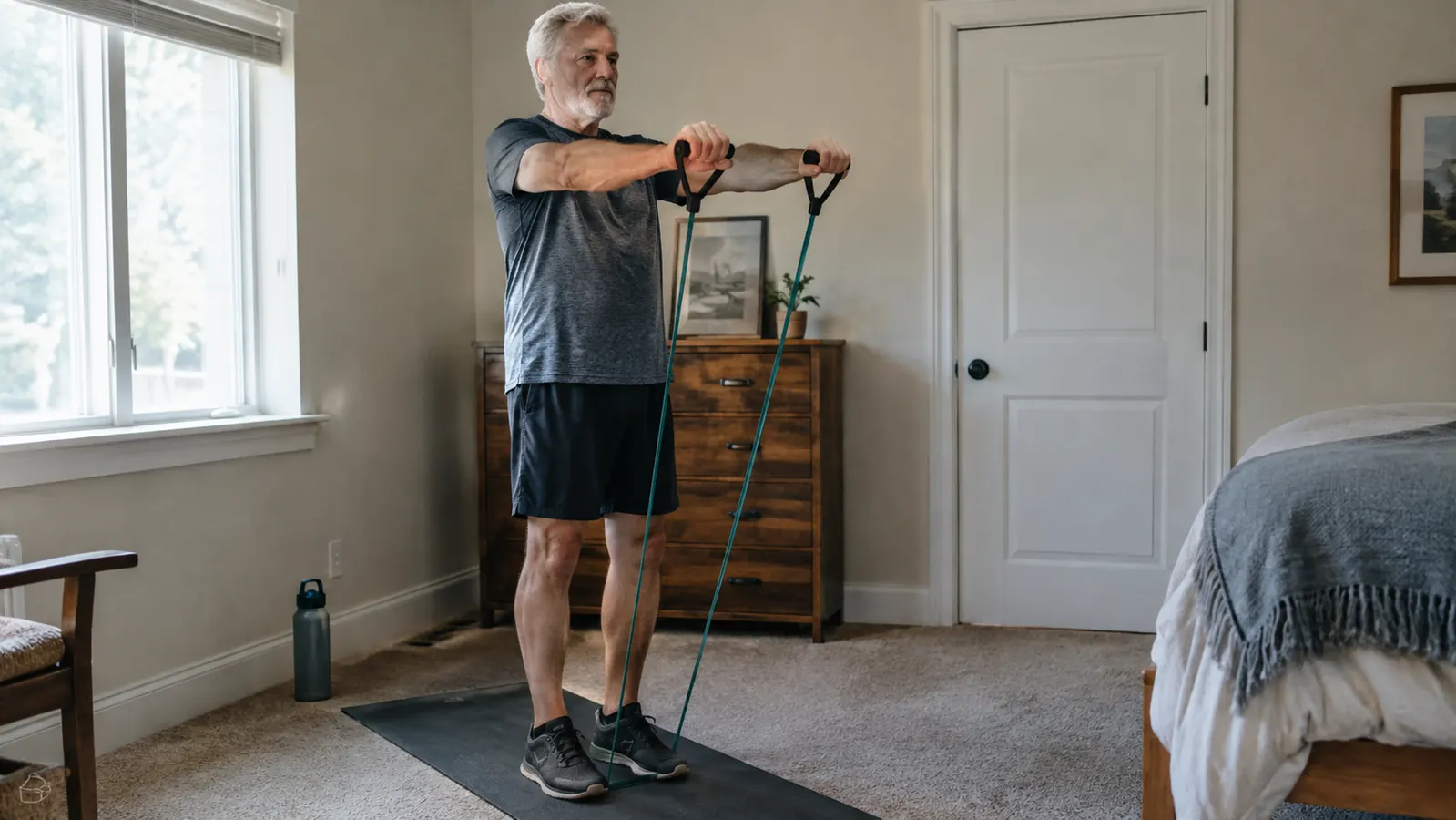
I bought the WHATAFIT resistance band set in August of last year, a couple of years after my doctor told me that losing leg strength was the thing most likely to take my independence. I'm Gene Holloway, 69, a retired rural mail carrier from Enid, Oklahoma. Three winters ago I took a fall on an icy porch step. No broken bones, but it scared me straight. I've been training in our spare bedroom ever since, and the WHATAFIT bands are the piece of equipment I reach for almost every morning.
Fourteen months and somewhere around 240 workouts later, I have a pretty clear picture of what this set does well, where it falls short, and who should buy it. This is that review, written the way I'd explain it to a neighbor over the fence.
The Quick Verdict
A well-made, well-priced band set that has held up through 14 months of daily use. Not the last word in home strength training, but the best first word I know for someone over 60 who wants to start today.
Amazon Check Today's Price →Start here: with a set that's simple enough to actually use
Five bands, two handles, two ankle straps, a door anchor, and a carry bag. I've used every piece of it, and it is still going strong after 14 months. Check today's price on Amazon and see if it fits your setup.
Amazon Check Today's Price on Amazon →How I've Used It
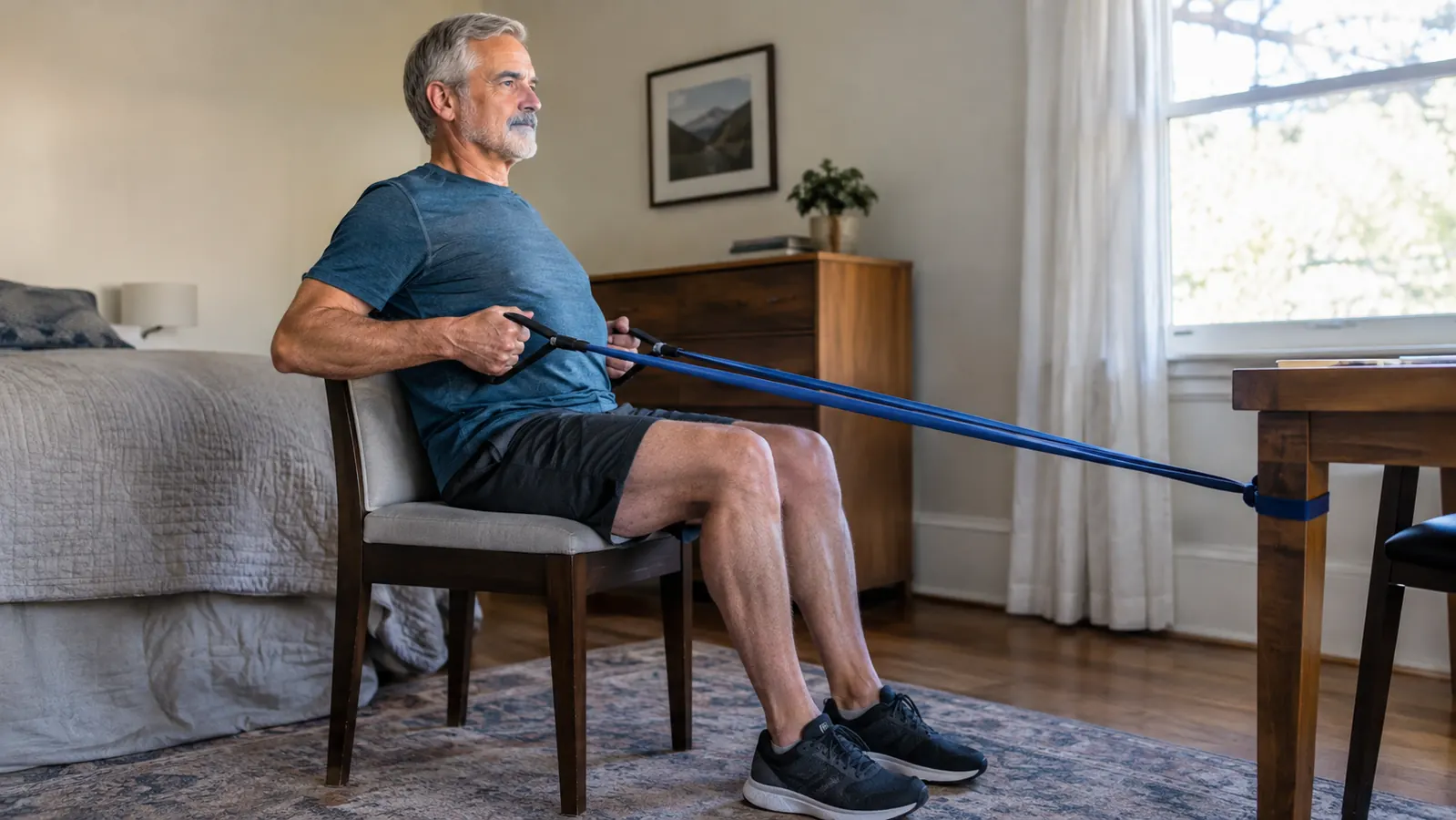
My routine is not complicated. Four mornings a week, usually Monday, Tuesday, Thursday, and Saturday, I do about 35 minutes in the spare bedroom. The room is roughly 11 by 12 feet, carpeted, with a rubber mat over part of the floor. I use the bands for rows, chest presses, shoulder presses, bicep curls, and a lot of leg work: squats with the bands under my feet, hip hinges, and the monster walk with the ankle straps, which is just sideways walking with the band around my ankles. My wife Carol, 67, joins me two or three times a week and uses the same set. She grabs the light and medium bands, I grab the heavy ones, and we hand them back and forth between exercises.
The first morning was a lesson in humility. I had watched a handful of videos the night before and figured I knew what I was doing, so I grabbed the medium band for everything. By the third exercise my shoulders were telling me I had made a mistake, and the next morning I was sore in places I did not know I had muscles. That is when I learned the most important lesson of this whole year: start with the light band and earn your way up. Once I switched to the light band for upper body work, the exercises started feeling right. I could complete the full range of motion instead of fighting the band the whole way, and the soreness settled into the good kind of tired.
The door anchor gets used on the days I do face pulls and lat pulldowns, which for me is twice a week. The ankle straps get used every single workout. The handles get used every single workout. Nothing has snapped, frayed, or lost its stretch. The only wear I can find is on the door anchor strap, which has rubbed against the door edge enough to look a little fuzzy. That fuzz showed up around month four and it has not gotten any worse since. I check it every month or so out of habit, and it is still holding fine. I keep the bands in the carry bag on a shelf in the closet when I'm done. The bag is nothing special, but it does the job and keeps Carol from tripping over bands on the floor, which she appreciates. When she trains with me, we take turns picking the music, and we have worked out a compromise that involves a little of both our tastes and a lot of teasing.
What the Set Actually Includes
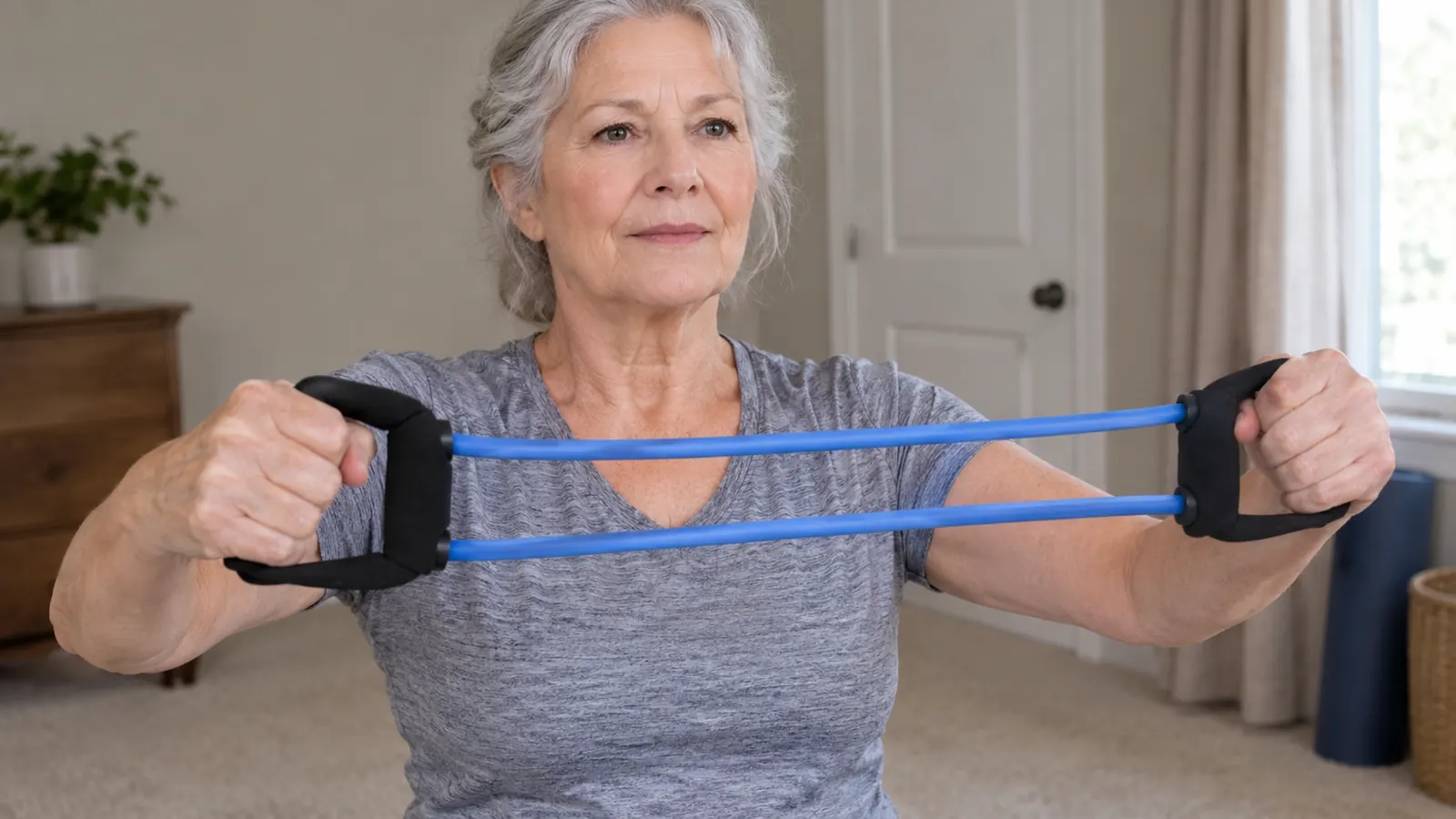
The WHATAFIT set comes with five latex bands color-coded by resistance: light, medium, heavy, extra heavy, and a heavier one that I honestly only used once I'd been training for about six months. Two padded foam handles, two ankle straps, one door anchor, and a carry bag round out the kit. The bands are long enough that I never felt like I was running out of band, whether I was doing a chest press with the band across my back or a squat with it under both feet.
The handles are the part I was most skeptical about, and they turned out to be the biggest surprise. The foam padding is dense enough that I don't feel the band digging into my palms, even on heavy rows. I have hands that have been through 31 years of mail routes, cold mornings, and truck doors, and I don't have any grip complaints. The ankle straps are wide and close with a strong Velcro that has not worn out, which is the part I expected to fail first. I have owned cheaper straps before, and the Velcro on those gave up after a few months of constant pulling and re-adjusting. These still grab clean on the first try.
The door anchor is a simple strap with a foam block on one end. You close the door on it, and it holds. I use it on the bedroom door, and it has not slipped or damaged the door. One note: the anchor works best on a door that closes flush. If your door has a big gap at the top, you may need to get creative. I learned this in a hotel room in Tulsa, where the doors have a wider gap than the ones at home. The anchor held, but I had to wedge it just right, and I could see how it would frustrate someone who did not feel like fiddling with it.
How It Holds Up Over Time
I have put roughly 240 workouts on this set, which works out to four mornings a week for just over 14 months. The bands are still elastic. The handles are still padded. The ankle straps still close tight. I inspect the bands before each use, running my fingers along the full length, and I have not found a crack, a nick, or a thin spot. That is the main thing I worried about when I bought them, and it has not happened. I check them the same way I used to check the tires on my mail truck before a long route, a quick once-over that takes ten seconds and buys peace of mind.
The one thing I would change is the printed resistance labels on the bands. They are printed on the latex itself, and after a year of rubbing against the handles and the floor, the labels on my two most-used bands have worn away. I know which band is which by color now, so it's not a problem for me, but if you're the kind of person who wants the label to stay readable, be aware it won't. Around month nine I noticed the label on the medium band starting to flake, and by month twelve it was gone entirely.
The other thing worth knowing: the bands have a faint rubber smell when they're new. It faded within a couple of weeks and has not come back. The closet where I store the set does not smell like rubber. The carry bag itself has also held up. It is not built like a piece of luggage, but after 14 months of being stuffed and unstuffed, the seams are holding and the drawstring still works.
Fourteen months in, the bands still feel as tight as the day I opened the box. That's the whole review, really.
What I Can Do Now That I Couldn't a Year Ago
I don't want to oversell this. Bands are not magic. But the numbers I care about have moved. I can get up out of a low chair without using my hands now, which I could not do a year ago. I can carry a full grocery bag up the porch steps without holding the railing. My left knee, which has mild osteoarthritis, complains less on stairs than it used to. My lower back, which complains if I sit too long, complains less on long car rides. The clearest moment came about eight months in, when Carol and I were loading the trunk at the garden center and I lifted a heavy bag of topsoil without thinking about it. A year earlier I would have wrestled with it and probably asked a store employee for help. It was not a dramatic moment. Nobody clapped. But I noticed, and that was enough.
The other change is less visible but maybe more important. I trust my legs now. After the fall on the ice three winters ago, I found myself watching the ground everywhere I walked, especially in winter. That caution has not disappeared, but it has dialed back. When I step off the porch or cross a parking lot, I am not bracing for a fall the way I used to. Some of that is confidence that comes from doing squats and hip hinges three times a week for a year. I cannot prove the bands did it, but I know the timing lines up.
I am not a doctor, and I am not going to tell you that resistance bands cured my knee. What I can tell you is that my physical therapist, who I see every couple of months for a tune-up, said my leg strength is noticeably better than it was at my last visit before I started. She also said the band work I'm doing is appropriate for my situation. If you have a health condition, run your plan past your own physician or physical therapist before you start. That's not a disclaimer, that's just sense.
What I Liked
- Five resistance levels mean I could start light and progress without buying anything else
- Padded foam handles stay comfortable even on heavy rows, no digging into the palms
- Ankle straps and door anchor make leg work and pulldowns possible with one set
- Everything has held up through 14 months and roughly 240 workouts with no fraying or loss of stretch
- Whole set packs into the carry bag, easy to take on a trip or use in a hotel room
Where It Falls Short
- Printed resistance labels on the bands wear off within about a year of daily use
- Door anchor needs a door that closes flush, a gap at the top makes it fiddly
- Latex bands are not for anyone with a latex allergy
- The heaviest band tops out well below what a serious lifter would need
Who This Is For
This set is for someone over 60 who wants to start strength training at home and does not want to spend a fortune or clear out a room for a rack of weights. It's for the person who wants to do something today, not after they've researched the perfect program. The WHATAFIT set is forgiving. If you're new to this, you can start with the light band and progress at your own pace. There's no heavy iron to drop on your foot, no machine to adjust, no gym membership to feel guilty about.
It's also for the person who travels. The whole set fits in the carry bag, and I have taken it on trips and used it in hotel rooms. The door anchor worked on the hotel door, and I got my workouts in without missing a beat. It is also for the couple who wants to train together. Carol and I share the set without any trouble. We split the bands by resistance before we start and trade as we go.
Who Should Skip It
If you're already lifting heavy and you're happy with your setup, this set is not going to replace your barbell. The heaviest band gives a solid challenge for someone my age, but a younger person who squats heavy will not be challenged by it. Skip it if you need progressive overload beyond what five bands can offer. There is a ceiling here, and it is lower than a rack of weights. That is not a flaw, it is just what this kind of tool is for.
Skip it also if you have a latex allergy. These bands are made of natural latex, and if your skin reacts to latex gloves or elastic waistbands, you need to look for a non-latex set instead. And if you are the kind of person who needs a screen and a class to stay motivated, this set will just sit in its bag. It's a tool, not a trainer. There is no app, no streaming workout library, no leaderboard. You have to bring the motivation yourself, and for me that was the point. But I know plenty of people who would rather follow along with an instructor, and for them, bands alone will not be enough.
The set that's been on my bedroom floor for 14 months
If you're over 60 and thinking about starting strength training at home, this is the set I'd hand you. Five bands, real handles, and it has held up to daily use. Check today's price on Amazon.
Amazon Check Today's Price on Amazon →