A few years ago, my doctor gave me a piece of advice that stuck. He said the thing most likely to take my independence was losing leg strength, not heart trouble or anything dramatic. That conversation sent me to the spare bedroom with a cheap thin mat and a simple plan, and a year and a half ago I swapped that mat for a BalanceFrom. I am 69, I have a stiff left knee with mild arthritis, and my lower back complains if I sit too long. I am not a fitness instructor and I am not a doctor. I am just a retired mail carrier who wanted to keep getting up and down off the floor without thinking about it.
The floor is where a lot of us older adults start to struggle. Getting down is easy. Getting back up is the test. If you practice on a thick mat, you give your knees and spine a softer surface and you give yourself the confidence to try. This guide is the routine I worked out with my wife Carol and, with her permission, with the okay of my own doctor. It covers stretching and floor exercises on a thick exercise mat, with the BalanceFrom All Purpose mat as the one I use every day.
A Mat That Makes the Floor Feel Safer
The BalanceFrom All Purpose mat is one inch thick, so my knees do not talk back the morning after a floor session. It stays put on carpet, rolls up with a strap, and costs less than a round of physical therapy copays. Check today's price on Amazon if you want to see it for yourself.
Amazon Check Today's Price on Amazon →Step 1: Clear the Space and Set Up the Mat
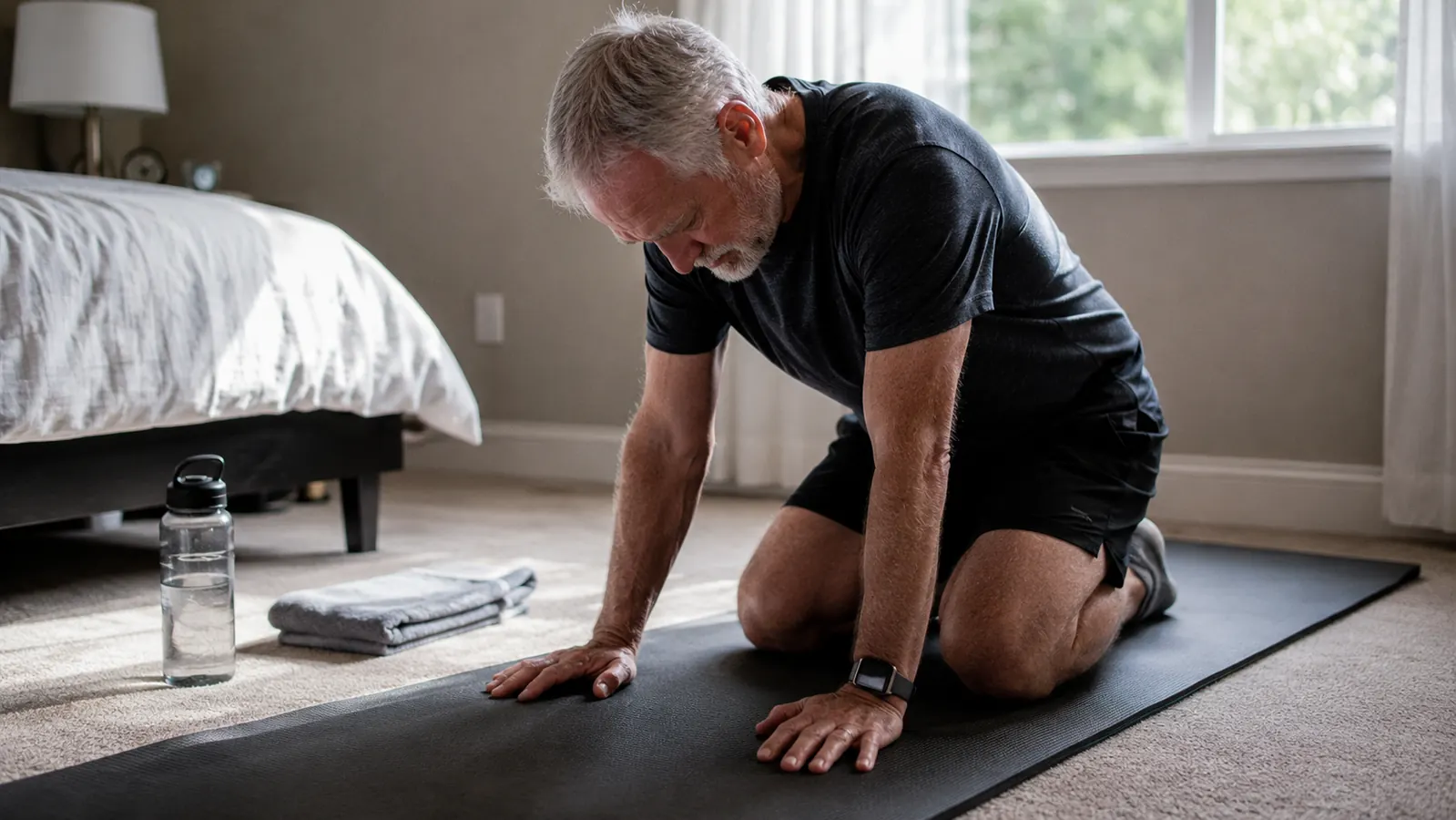
My gym is a spare bedroom, about 11 by 12 feet, with carpet. I cleared the middle of the floor, moved the chair against the wall, and laid the BalanceFrom mat down with the textured side up. The mat is one inch thick, which is thicker than most yoga mats. That thickness matters when your knees and tailbone are the parts doing the pressing. I also keep a folded towel at one end for my head and a water bottle just off the mat. You do not need a lot of room. You need enough room to lie flat with your arms out and enough clear space that you are not worried about hitting a dresser.
Before you buy a mat, check that it is long enough. I am 5 foot 10 and the BalanceFrom mat gives me a few inches of spare at both ends. If you are taller, look for an extra long version. The carrying strap matters more than I expected. I roll the mat up after each session and strap it so it does not unroll in the closet. That keeps the mat clean and keeps me from tripping over it later. I also put a small clock where I can see it. It is easy to lose track of time on the floor, and I like knowing when I have hit my twenty-five minutes. A phone timer works too, but I leave my phone in the other room so I am not tempted to check it between stretches.
Step 2: Warm Up Before You Stretch
I made the mistake of stretching cold when I first started. My back did not appreciate it. Now I spend five minutes warming up before I get on the mat. March in place next to the mat, swing your arms, do a few slow knee lifts. The goal is to raise your body temperature, not to break a sweat. When my knee is stiff, I also stand at the edge of the mat and do ten slow heel raises, holding the wall for balance. That small warm-up makes the floor work feel completely different.
Warming up is also the time to check in with yourself. If something hurts sharply, that is information. A dull ache from arthritis is one thing. A sharp pain is a reason to stop and call your doctor. I keep a note on my phone with the date and how my knee felt. After a few weeks, you can look back and see real patterns. That is more useful than any fitness app I have tried. One more note on warming up: if the room is cold, wear a long sleeve shirt and light pants. Cold muscles are tighter muscles. In the winter, I run a small space heater in the bedroom for ten minutes before I start. That is not luxury, that is just practical.
Step 3: Start With the Basic Floor Stretches
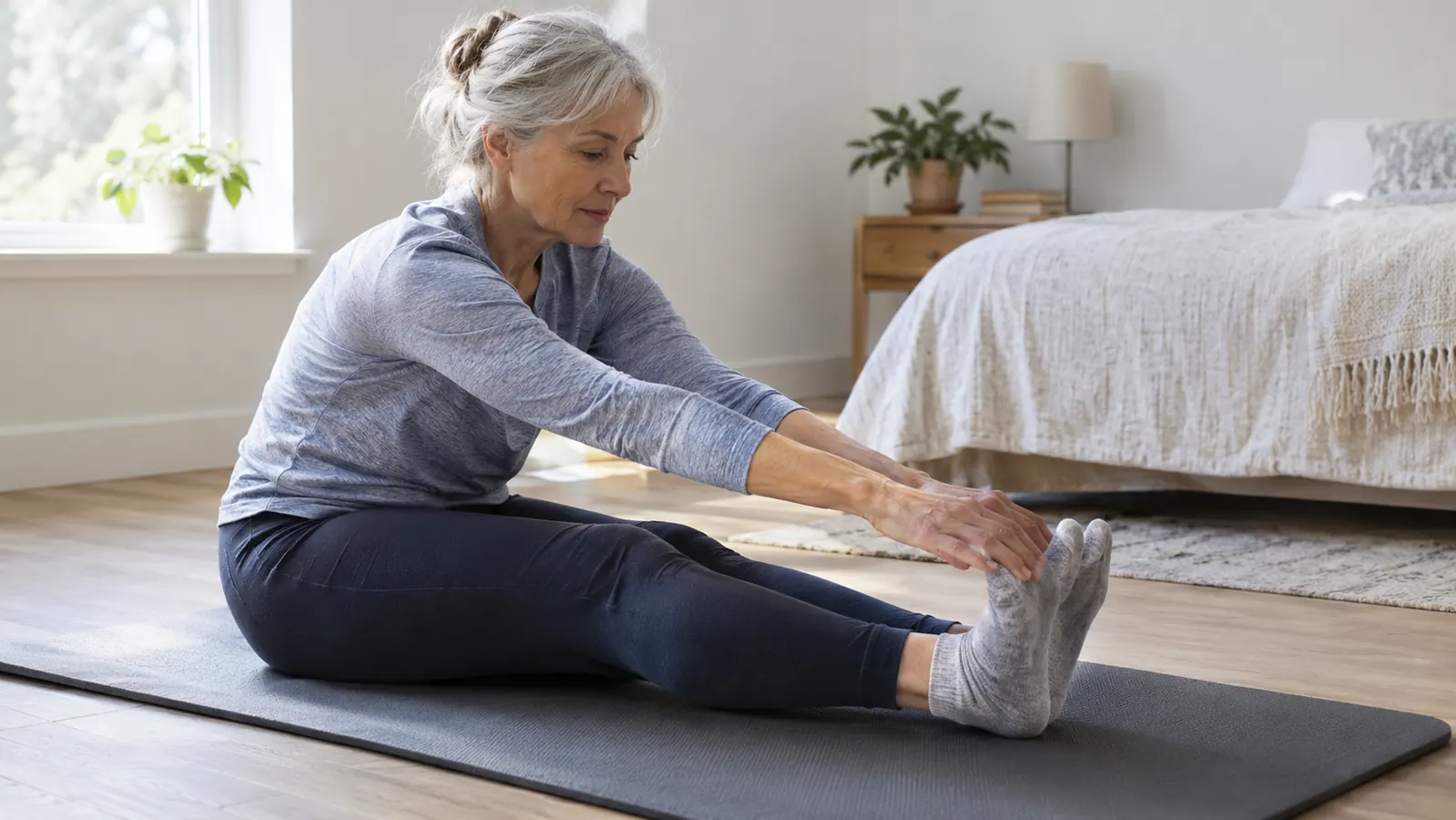
Once you are warm, sit on the mat with your legs straight out in front of you. This is the position I use to check my hamstrings. I sit tall, I do not force anything, and I lean forward just until I feel a gentle pull behind my knees. I hold for twenty seconds and breathe. The BalanceFrom mat gives me enough cushion that my tailbone does not go numb, which was the reason I quit doing floor stretches on the carpet years ago.
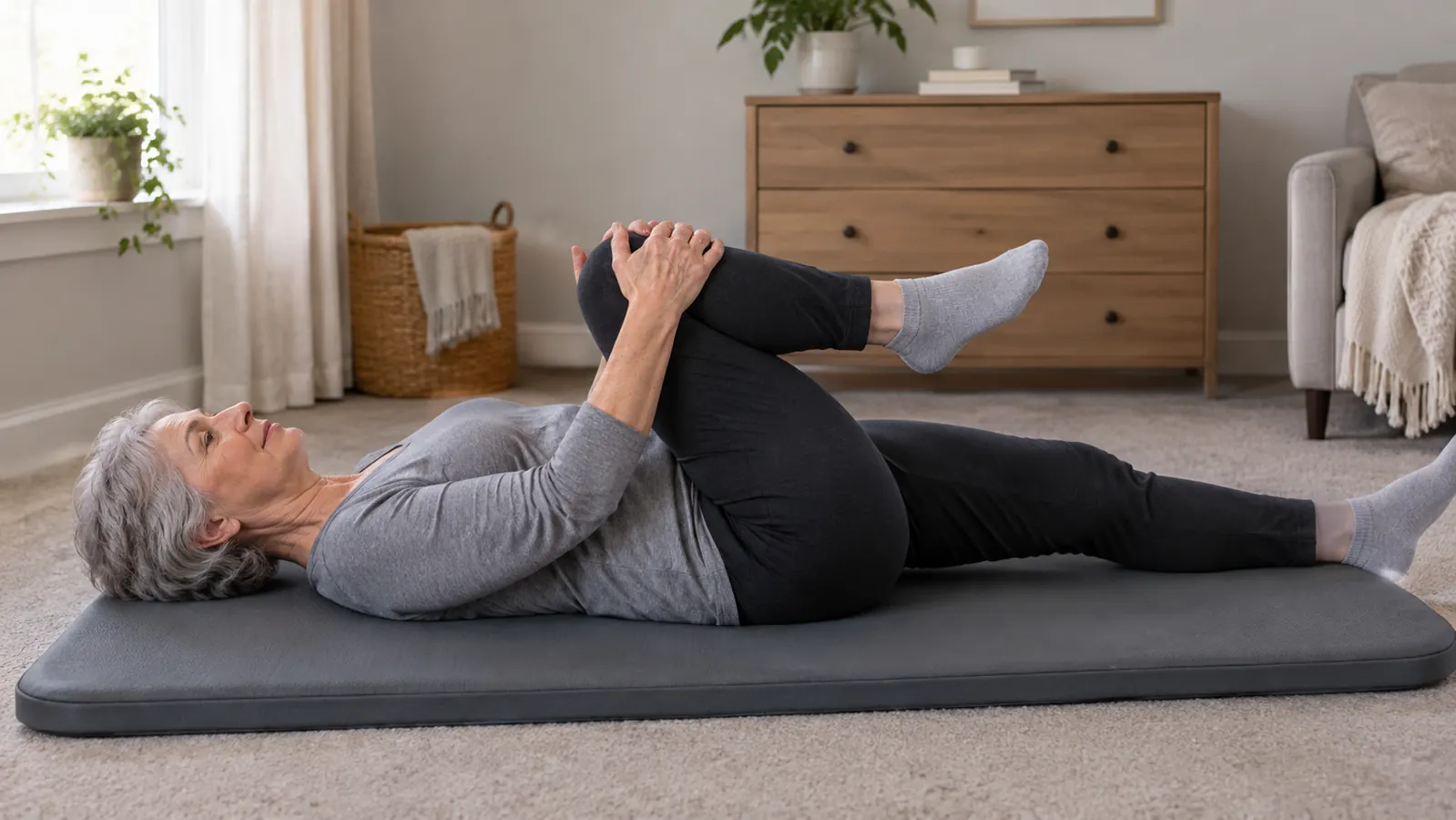
The second stretch I do every session is a knee to chest. I lie on my back, draw my right knee toward my chest, and hold it with both hands. Then I switch sides. This one is especially good for my lower back. I follow it with a gentle spinal twist: knees dropped to one side, shoulders staying on the mat. If you have had hip or back surgery, check with your physical therapist before trying twists. I am not a doctor, and I would rather sound overly careful than have you hurt yourself.
Hold each stretch long enough to feel it work, but never bounce. Bouncing is the fastest way to pull something. I count slow breaths instead of seconds. Ten slow breaths is usually about thirty seconds and it keeps my mind on the stretch instead of the clock.
Step 4: Add Gentle Strengthening Moves
Stretching alone will not rebuild leg strength. My doctor was clear about that. So I add three floor exercises that do not require any equipment beyond the mat. The first is a glute bridge. I lie on my back with my knees bent and feet flat, then I lift my hips until my body makes a straight line from shoulders to knees. I hold for two seconds and lower slowly. I started with five and worked up to twelve. The mat keeps my shoulder blades from grinding into the floor.
The second exercise is a seated leg raise. I sit on the mat, lean back on my hands, and lift one leg a few inches off the floor. I hold it for a few seconds and lower it. This works the front of the thigh without putting weight on the knee. The third is a bird dog, done on hands and knees. I extend one arm and the opposite leg, hold for a moment, and bring them back. The BalanceFrom mat is thick enough that my knees stay comfortable in this position, which is the whole reason I keep recommending it to friends my age.
Start with one set of each and add a rep every few days. If you feel unsteady, do the moves near a sturdy chair so you can reach for it. Carol does the same routine next to me on her own mat, and she likes a thick one for the same reason I do: it stays flat on the carpet even when she pushes off with her hands. A mat that slides under you is dangerous, and the BalanceFrom has a grippy bottom that has never moved on me. I keep a small cushion under my head for the bridge and the knee to chest stretch. The mat handles the back, but the cushion keeps my neck in line. You can use a folded towel. The point is to keep your spine neutral so you are not straining your neck to see what your feet are doing.
Step 5: Cool Down and Listen to Your Body
When the last exercise is done, I stay on the mat for a minute. I lie on my back, knees bent, and just breathe. Then I roll to my side and push myself up with my hands. That roll to the side is a habit worth practicing. It is the safest way for an older adult to get up from the floor, and doing it on a padded mat makes it easier to learn. I also do a final hamstring stretch while I am still warm.
After I roll up the mat, I write down how the session felt. Some days my knee is grumpy and I do fewer reps. Some days I feel ten years younger. Both are fine. The point is to keep showing up. I train three days a week, usually Monday, Wednesday, and Friday. On the other days I take a walk. That mix has kept me moving for three years now, and the BalanceFrom mat has held up for the last year and a half with no tears and no flattening in the spots where my knees press. I used to jump up right after the last stretch. Now I take that minute to breathe and let my heart rate settle. It also gives me a chance to notice any sore spots. If something feels off, I can adjust the next session instead of ignoring it.
If you are new to floor exercise, give yourself six weeks before you judge the routine. The first two weeks are mostly about learning how your body moves on the mat. The next two are about building a habit. By week six, the movements start to feel normal. That is when the real gains show up, in how easily you get out of a chair or pick something up off the floor.
Common Mistakes That Will Set You Back
The biggest mistake I made was doing too much too soon. I started with twenty repetitions of everything and paid for it the next day. Your muscles and joints need time to adapt, especially if you have spent years avoiding the floor. Start with five reps and add one per week. That sounds slow, but slow is what keeps you training next month.
The second mistake was holding my breath. When I concentrated on a movement, I would forget to breathe, and then I would feel lightheaded. Now I exhale on the effort and inhale on the release. If you find yourself holding your breath, slow down. The exercise is not a test of willpower.
The third mistake was comparing myself to how I moved at forty. That version of me is gone, and that is fine. The goal now is to be stronger than I was last month, not to match some old memory. Carol reminds me of this whenever I get frustrated. She is usually right.
How to Fit This Into a Busy Week
You do not need an hour. My whole session, from warm-up to cool-down, takes about twenty-five minutes. I do it before breakfast, three days a week. The mat stays rolled in the closet, so setup takes less than a minute. If twenty-five minutes feels like too much, start with ten. Ten minutes on the floor is still ten minutes more than most people your age are doing.
I also pair the routine with something I already do. I listen to the radio while I stretch, and I do the strengthening moves during the news break. That sounds small, but it means I never have to decide whether to train. The decision is already made. If you can find a trigger like that, the habit will stick.
What Else Helps
A mat is only one piece. I also keep a sturdy chair nearby for balance, wear shoes with good grip even indoors, and do the routine at the same time of day so it becomes automatic. Lighting matters too. I added a small lamp so the room is bright enough to see the mat edges clearly. And I drink water before and after, not during, because sipping while lying down is awkward. The biggest helper, though, is consistency. A so-so session three times a week beats a perfect session once a month. One thing I did not expect: the mat is also useful for the days I do not exercise. I use it as a kneeling pad when I am sorting through boxes in the closet. That is a small bonus, but it means the mat earns its place in the room even on rest days.
A mat that slides under you is dangerous. The BalanceFrom has never moved on me, and that is the whole reason I trust it.
Start With One Session Today
You do not need a gym membership or a coach. You need a quiet corner, a thick mat, and a plan you can repeat. The BalanceFrom All Purpose mat is the one I have used for a year and a half, and it is still flat and grippy. Check today's price on Amazon and give yourself the gift of a safer floor.
Amazon Check Today's Price on Amazon →