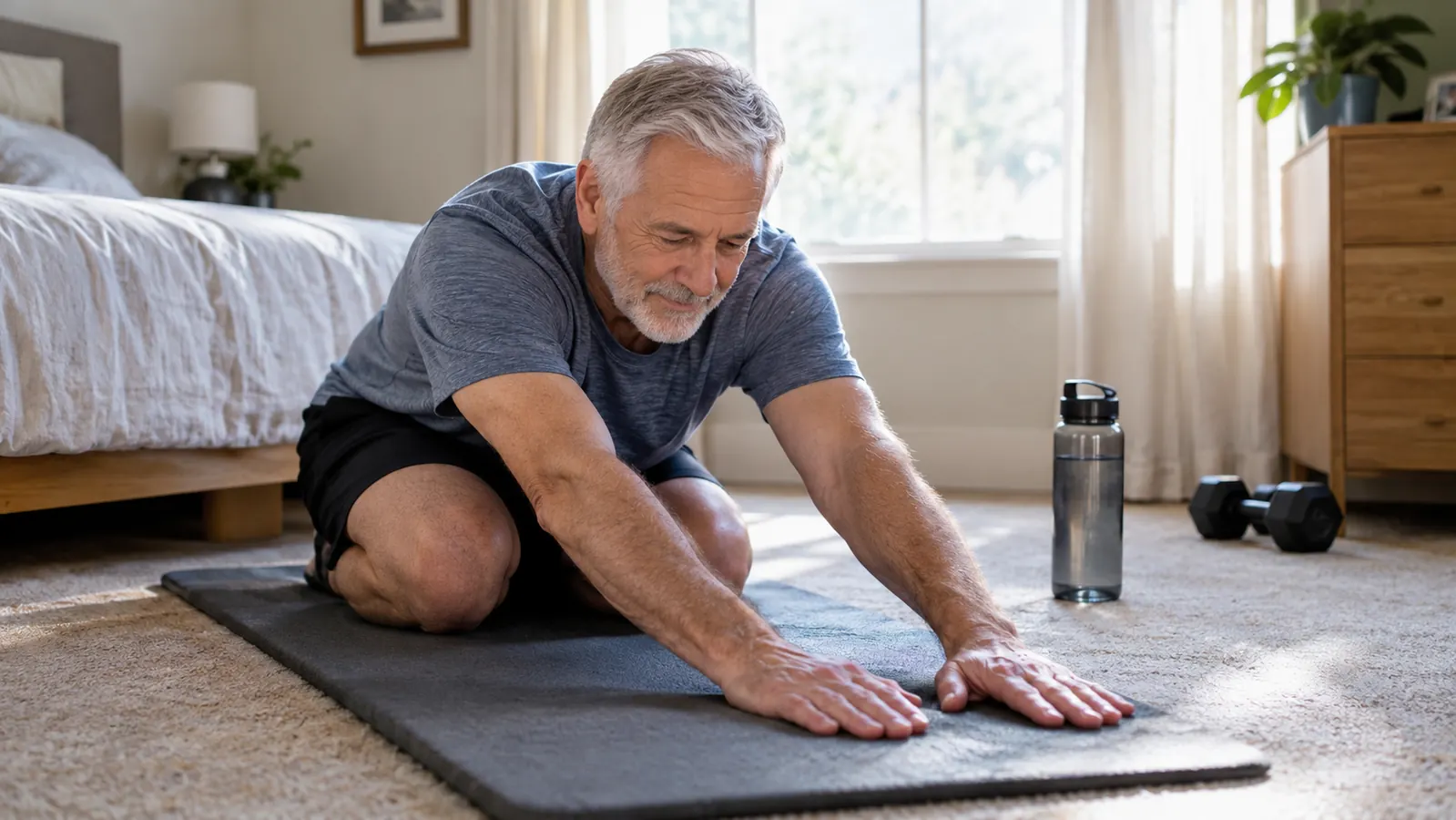
The first time I lowered myself onto a standard yoga mat in my spare bedroom, my left knee made its opinion known within about thirty seconds. That knee has mild osteoarthritis, and the carpeted floor underneath that thin mat may as well have been concrete. I am 69 years old, I spent 31 years carrying mail on a rural route, and I did not start training at home until I was 66. A fall on an icy porch step three winters ago scared me straight, even though I did not break anything, and when my doctor told me that losing leg strength was the biggest threat to my independence, I took it as the warning it was. What surprised me was that the mat under my knees mattered almost as much as the exercises themselves.
This is a plain-spoken comparison between the BalanceFrom 1-inch thick exercise mat and a standard yoga mat, written for other adults in their sixties and seventies who are doing the same thing I am: trying to stay strong and steady at home. I have used both on the carpeted floor of an 11 by 12 foot spare bedroom for a year and a half, and I have a clear answer. If most of your work is on the floor, stretching, strength moves, and knee-friendly exercise, the BalanceFrom is the better choice. If you mostly stand and move through yoga poses, a standard mat may serve you fine. The rest of this article is the reasoning behind those two sentences, including the places where the standard mat wins, because there are a few.
| BalanceFrom 1-Inch Mat | Standard Yoga Mat | |
|---|---|---|
| Cushioning for knees and hips | 1 inch of high-density foam, real padding under a stiff joint | A few millimeters of thin mat, the floor comes through fast |
| Stability for standing balance | Thicker foam can shift underfoot during one-leg work | Thin and close to the floor, a more planted feel |
| Price | Costs more up front, built to last for years | Costs less, often replaced sooner |
| Portability | Heavier and bulkier to carry around the house | Lighter and rolls up small |
| Durability | Anti-tear high-density foam holds up to daily use | Thin mats crease and wear over time |
| Best for | Floor work: stretching, strength, knee-friendly exercise | Standing yoga flow and balance work |
| Cleaning | Wipes down with a damp cloth | Also wipes down easily |
Where the BalanceFrom Mat Wins
The reason I bought the BalanceFrom in the first place was simple: my knee. Floor work is the backbone of the routine my physical therapist gave me, and a lot of it happens on all fours or seated on the floor. On a standard mat, I could feel the floor through the material within a minute, and my knee would start to ache before the warmup was done. On the BalanceFrom, with a full inch of high-density foam under me, I can kneel through an entire session without that ache. That is not a small thing when you are 69 and every session is a small vote for staying independent. The cushioning is the whole point, and it delivers.
The durability has impressed me just as much. I use this mat daily, sometimes twice, and I am not gentle with it. I drop to my knees, I sit on it, I drag it across the carpet to reposition it. After a year and a half, there are no tears, no permanent dents, no spots where the foam has flattened out. The anti-tear construction is not just a label. Carol, who is 67 and trains alongside me a few times a week, does her floor stretches on her own mat, and mine still looks and feels the same as the day it arrived. For anyone who remembers buying cheap mats that wore out in a few months, this is the difference that justifies the purchase.
Where a Standard Yoga Mat Wins
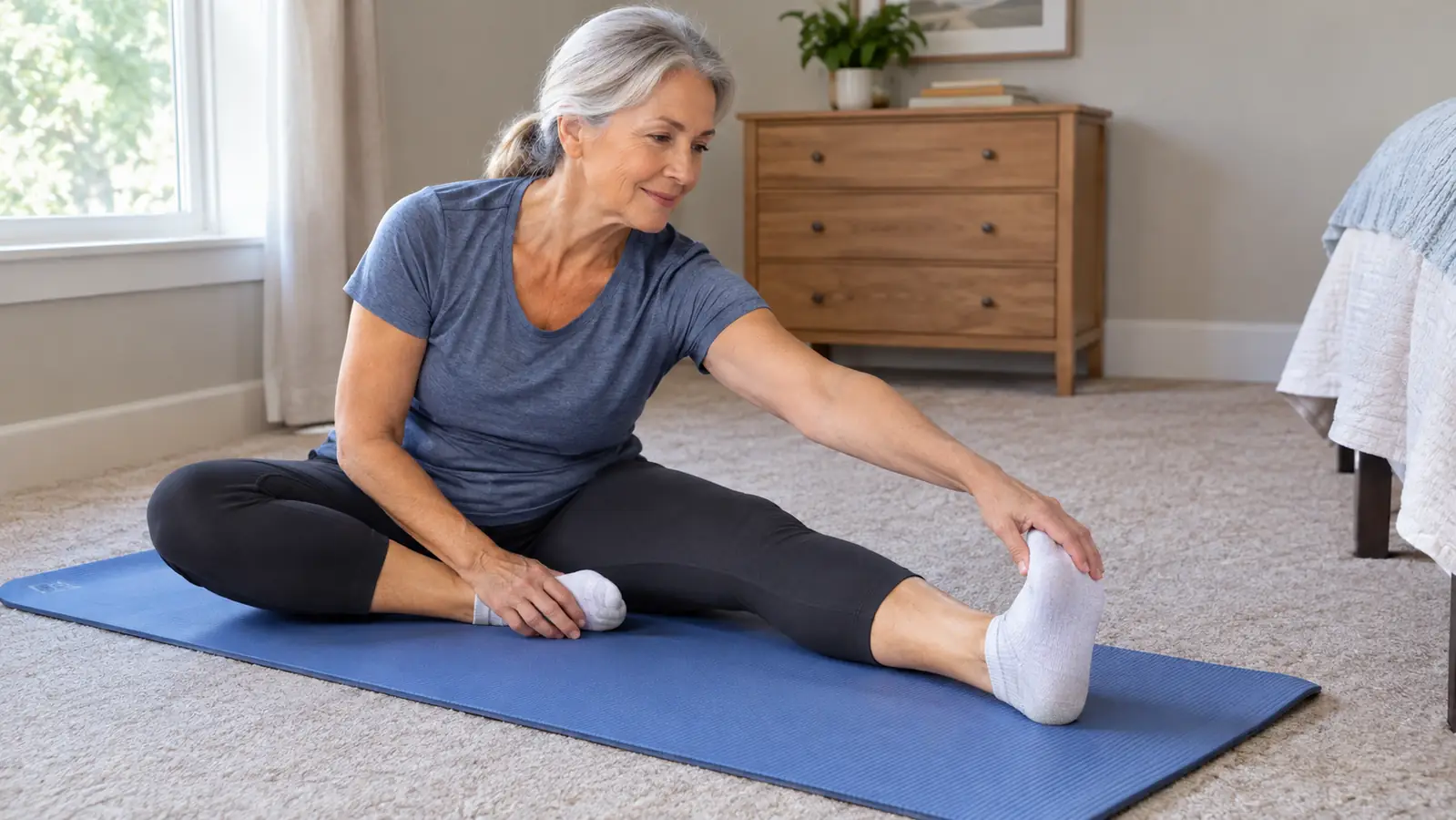
Now the part that surprised me, because it is a real tradeoff and I do not want to hide it. A standard yoga mat is better for standing balance work. The BalanceFrom is thick, and thick means the surface gives a little under your feet. When I do one-leg stands or slow balance moves, I can feel the foam compress, and that tiny bit of give makes the exercise harder in a way that has nothing to do with my legs. On a thin mat, you are closer to the floor and the surface is more planted. If balance is your main goal, that stability matters more than cushioning ever will.
A standard mat also wins on portability and price. It is lighter, it rolls up smaller, and it costs less. If you travel, or if you want a mat to keep in the living room for a few minutes of stretching while you watch the news, a thin mat is easier to live with. And honestly, if your routine is mostly standing yoga, the extra cushioning of the BalanceFrom is something you will hardly notice, because you are not on the floor that much. In that case, paying more for thickness is hard to justify. I am not going to pretend otherwise just because I own the thick one. The right tool depends on the job.
The difference was not subtle. On the thin mat my knee complained within a minute. On the BalanceFrom I finished the whole session.
If your knees talk to you on the floor, this is the mat to try
The BalanceFrom 1-inch mat is the one I reach for every single day in my home gym. Check today's price on Amazon and see if it works for you.
Amazon Check Today's Price on Amazon →How I Compared Them
I did not do anything scientific. I had used a standard mat for my first year and a half of training, then switched to the BalanceFrom, then went back and forth over a period of months to see if my first impression held up. Carol watched me go through this and rolled her eyes more than once, though she has since gotten a thick mat of her own for her stretches. I kept the test simple: the same exercises, the same carpeted floor, the same knee. The pattern was consistent. Any move that put weight on my knees or hips felt noticeably better on the thick mat. Any move that required a firm footing felt slightly better on the thin one. After a while I stopped bothering with the thin mat altogether.
I also paid attention to the small things that do not show up in a spec sheet. The BalanceFrom comes with a carrying strap, which I use to hang it on a hook in the closet when it is not in use. It stays put on the carpet, even when I am moving through exercises, because the rubber section of my floor gives it something to grip. And the surface gives me enough traction that my hands do not slip when I am in a plank or on all fours. Those details matter more than I expected, especially for someone who was never the most coordinated person in the gym.
How Thick Is Too Thick?
Once you start looking at thick mats, you will see half-inch versions and even two-inch versions, and you might wonder if more is always better. In my experience, one inch is the sweet spot for an older adult doing floor work. Half an inch helps, but you can still feel the floor through it on a hard surface. Two inches feels like lying on a mattress, which sounds nice until you try to do a balance move on top of it and realize you are wobbling for no good reason. One inch gives you real cushioning without turning the floor into a trampoline.
The other thing to consider is what surface you are putting it on. My spare bedroom is carpeted, so the BalanceFrom sits on top of a surface that already has a little give. On bare hardwood or tile, the same mat will feel firmer, and that is worth knowing before you order. If your floor is hard, the extra inch matters even more. If your floor is already soft, you might get away with a thinner mat. But for most people in our age group, on most floors, one inch is the number that works.
What a Typical Session Looks Like
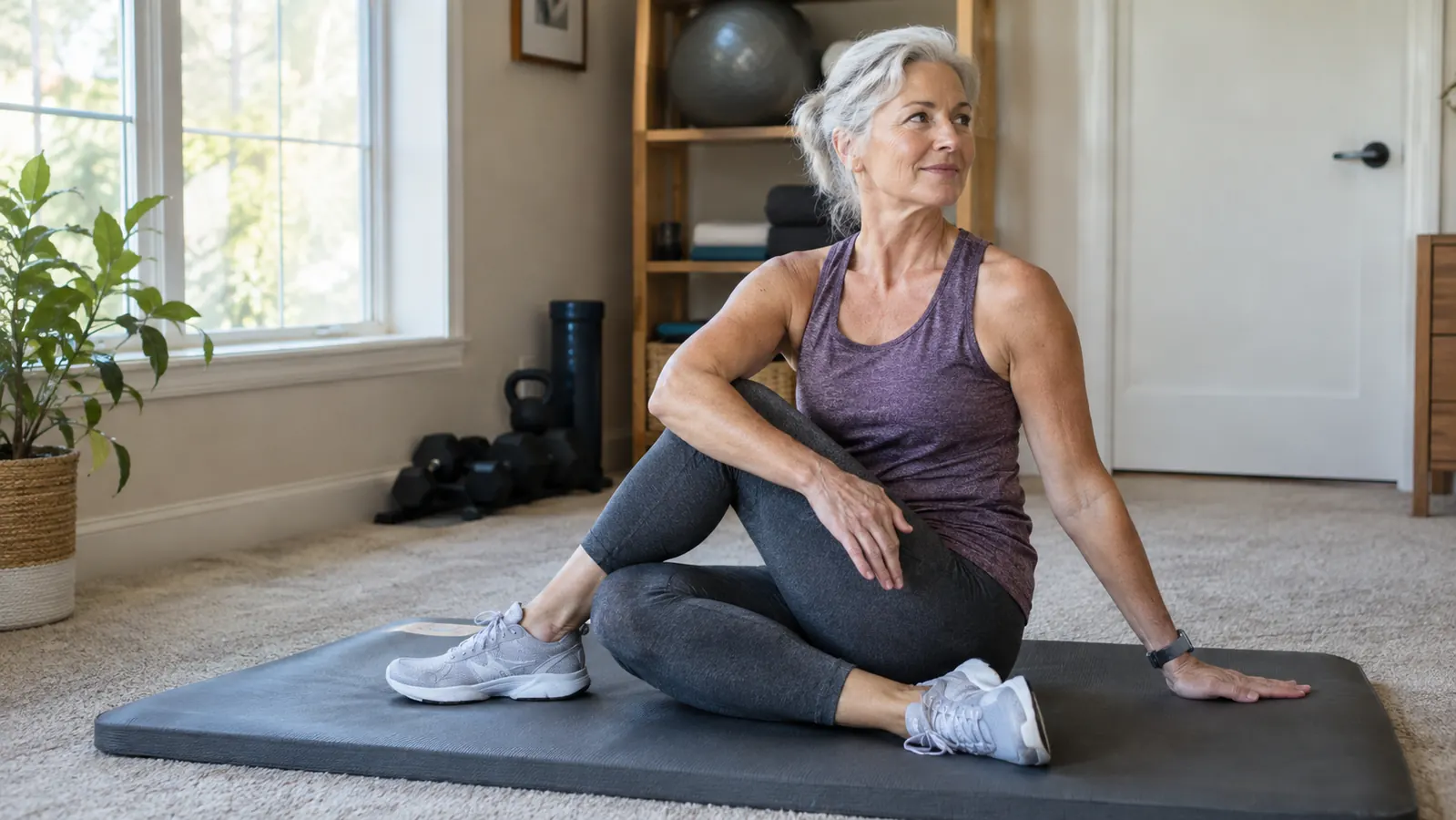
Most mornings I start with five minutes of gentle movement on the BalanceFrom: a few knee-to-chest pulls, some hip rocks, then a slow hamstring stretch. The mat stays put the whole time, which matters more than you might think. On the old thin mat, the corners would curl and the whole thing would slide a few inches on the carpet, and I would spend more time adjusting it than stretching. With the thick mat, I set it down, I use it, and I roll it up when I am done. That sounds like a small thing, but at 6 in the morning it is the difference between a routine I keep and a routine I skip.
The other thing I notice is how little my lower back complains during floor work on the thick mat. My back is not what it used to be, and sitting directly on a hard floor used to make it grumble by the end of a session. The inch of foam changes that. I can sit, kneel, and lie down for the full routine without counting the minutes until it is over. That is the practical benefit that keeps me coming back.
Who Should Buy Which
Buy the BalanceFrom if your routine is mostly on the floor. That means stretching, hip and knee mobility work, core exercises on your back, or any strength move that puts weight on your knees. If you are in your sixties or seventies and your joints complain on hard surfaces, the extra inch of foam is the difference between a session you finish and a session you cut short. That is not an exaggeration; it is what I experienced every time I went back to the thin mat. My physical therapist approved of the setup, and that mattered to me. This is the mat I use, and the one I would buy again without thinking twice.
Buy a standard yoga mat if you mostly stand. If your practice is built around standing poses, balance work, and movement from one pose to the next, a thin mat gives you a firmer, more planted surface, and it costs less and stores easier. And if you are not sure which camp you are in, start with the BalanceFrom anyway. Floor work is where most beginners in our age group spend their time, and the cushioning protects you while you figure out what you actually enjoy. You can always add a thin mat later for standing work, which is exactly what I would do if I were starting over.
A Few Practical Notes
One thing I learned the hard way: a thick mat does not fix a bad setup. I still do my balance work near a wall or a sturdy chair, because the foam gives a little and I would rather grab something than test my reflexes. I keep the mat on the rubber section of my floor so it does not slide, and I wipe it down with a damp cloth after sweaty sessions. I also roll it loosely for storage and hang it with the strap, which keeps it flat and ready for the next day. None of this is complicated, but it is the kind of detail that makes the mat work for you instead of the other way around. If yours arrives rolled, give it a day to lie flat before your first session.
The Bottom Line
If you are over 60 and training at home, your joints are the bottleneck, not your motivation. The BalanceFrom takes the floor out of the equation so the work you do is the work you planned, not the work you can tolerate. A standard yoga mat is fine for standing practice and easier on the budget, but for the floor work that builds the strength you need to stay independent, give me the inch of foam every time. That is the honest answer, and it is the one I would give anyone my age.
Give your knees a fighting chance on the floor
The BalanceFrom has held up to daily use in my home gym for a year and a half. Check today's price on Amazon and see why I reach for it every day.
Amazon Check Today's Price on Amazon →