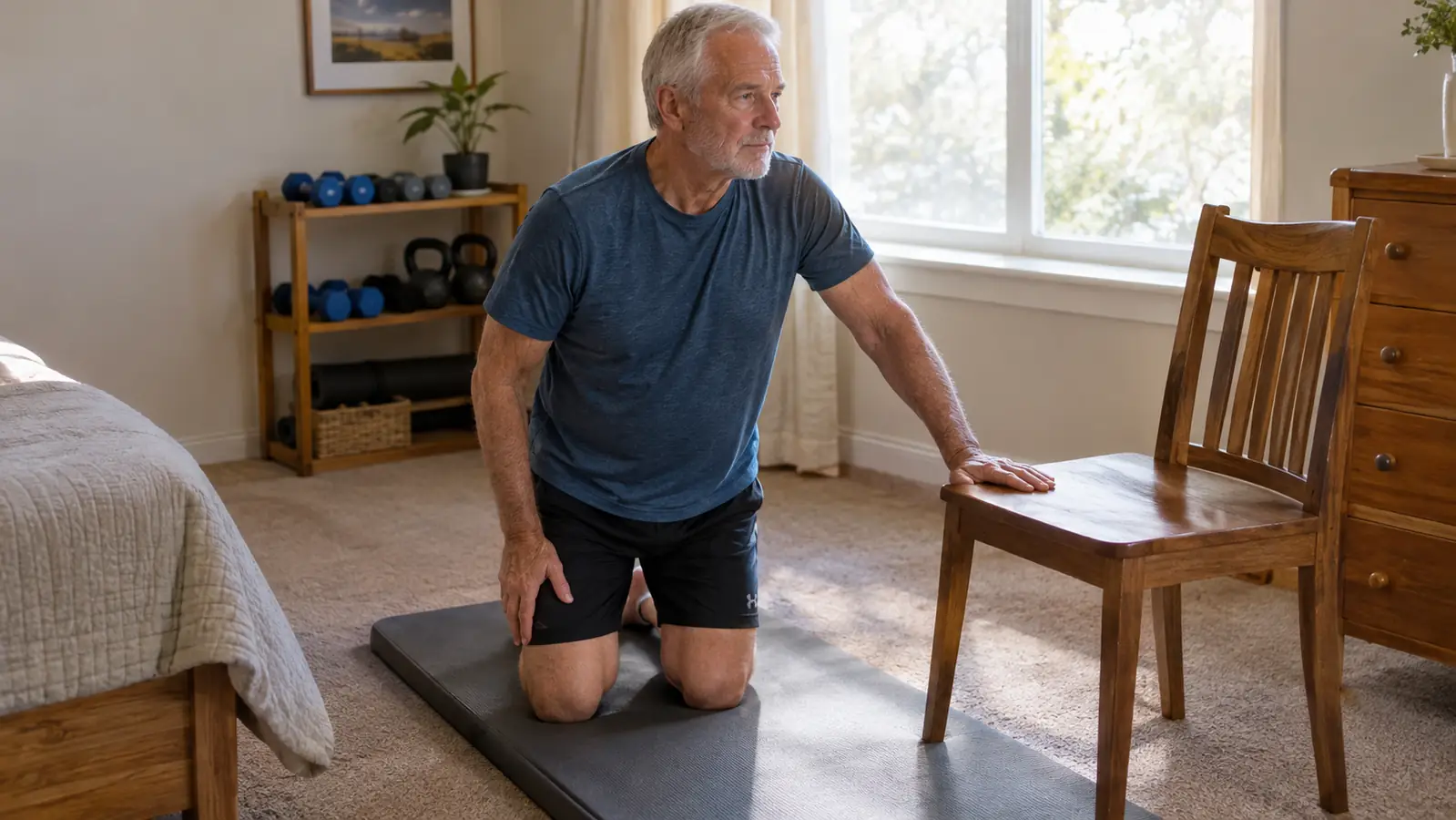
Three winters ago I took a fall on the icy porch step at the back of our house in Enid, Oklahoma. No broken bones, but it scared me more than anything in years. When I told my doctor about it, she said something I have not forgotten: the thing most likely to take my independence was not my heart or my blood pressure. It was leg strength. Lose it, she said, and you lose the ability to get up off the floor, out of a chair, up from the toilet. That conversation is the reason a 69-year-old retired mail carrier has a small home gym in his spare bedroom, and it is the reason I care about something as ordinary as an exercise mat.
This is the honest review of the BalanceFrom 1-inch exercise mat that I wish someone had written for me before I ordered one. Not a spec sheet, not a list of features. The things nobody tells you: how heavy it is, how it behaves on carpet, why it is the best thing I own for floor work and the wrong tool for standing balance exercises. I have used this mat nearly every day for a year and a half. Carol has used hers a few days a week for most of that time. Here is what we learned, the good and the bad, with nothing polished up for the sake of a review.
The Quick Verdict
The best cushioning mat I found for floor exercises, with honest tradeoffs. It protects knees and hips beautifully, but it is heavy, bulky, and too soft for standing balance work. Buy it for your knees, not for yoga.
Amazon Check Today's Price →The mat I kneel on every morning
If floor work is part of your routine, this is the mat that made my knees stop complaining. Check today's price on Amazon and see if it fits your setup.
Amazon Check Today's Price on Amazon →How I've Used It
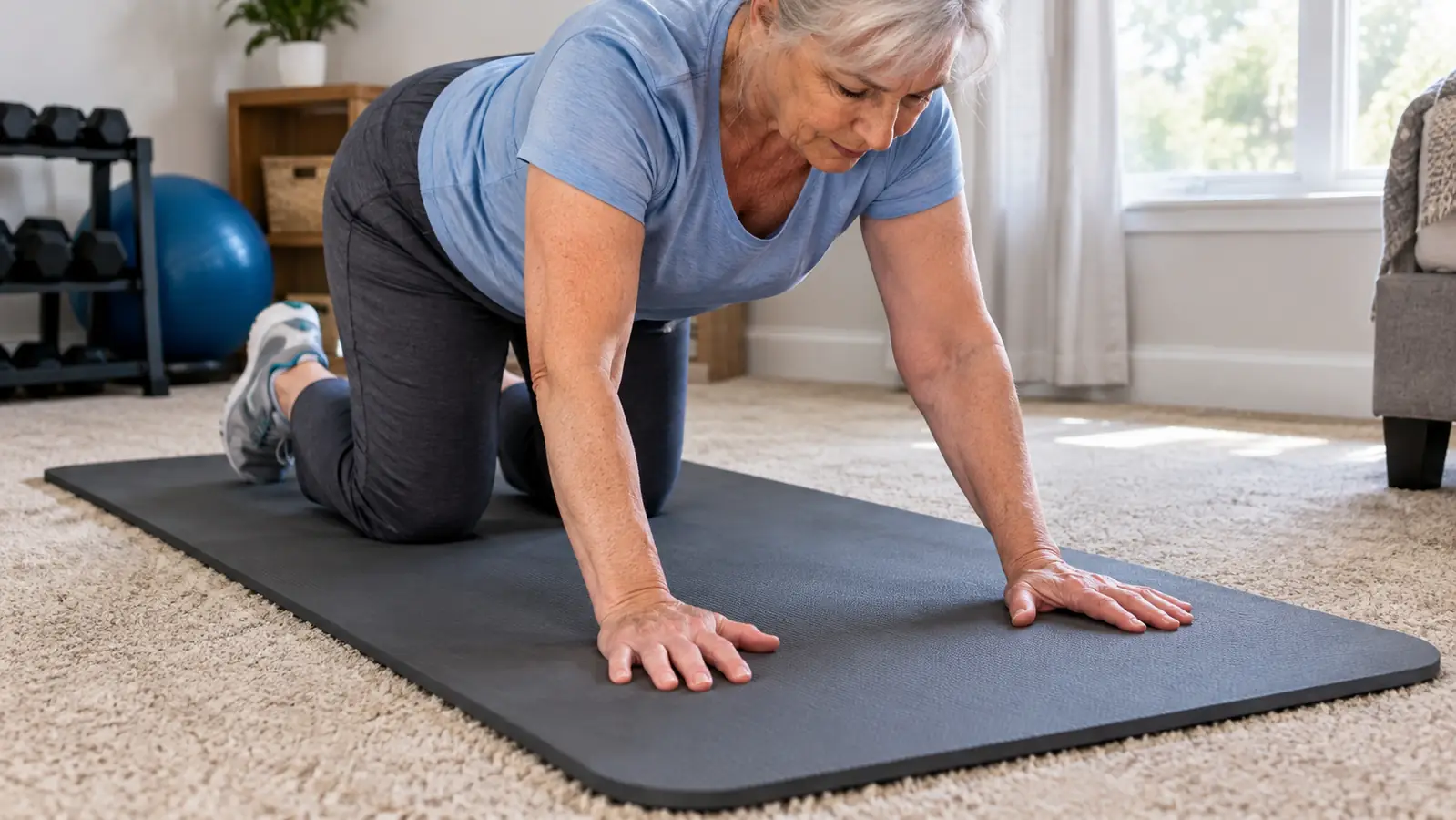
Every morning after coffee, I do about 25 minutes on this mat. Carol joins me a few days a week. The routine has changed over time, but the mat has been the constant. I started with the exercises my physical therapist gave me: seated leg lifts, standing calf raises holding the back of a chair, and floor work for the hips. The floor work was the problem. Our spare bedroom is carpeted, and carpet is a poor surface for exercise. My left knee, which has mild osteoarthritis, complained every time I knelt or lay on the floor. The rubber mat I put over part of the carpet helped, but it was thin. I needed more cushion.
The BalanceFrom mat changed that. At one inch thick, it is dense enough that I do not feel the floor through it, but firm enough that I do not sink into it the way I do in a cheap foam mat. I use it for hip bridges, clamshells, hamstring curls with a towel, and a set of lower back exercises for the stiffness I get from sitting too long. Carol does her routine beside me on her own mat. Mine stays on the floor. Hers stays in the closet until she needs it. That arrangement tells you something about how we both feel about it: the mat earns its floor space.
One thing I will say plainly: this is not a mat you carry around the house. It is heavy. The carrying strap works, but at my age I use it to move the mat from the floor to the wall, not to lug it to the park. It lives in the spare bedroom, which is fine, because that is where I train. If I had planned to roll it up and move it between rooms every day, I would have found it frustrating. Knowing that in advance would have saved me a surprise, and it is exactly the kind of thing the reviews do not mention.
The first few weeks, I kept the sessions short and simple. My physical therapist warned me not to overdo it, and she was right. The mat made the floor work comfortable enough that I wanted to do more, which is a good problem to have. I built up from ten minutes to twenty-five over about a month. Carol started the same way. The mat did not change overnight, but it made the habit stick, because I was not dreading the part where I had to get down on the floor and back up.
What Nobody Tells You Before You Buy One
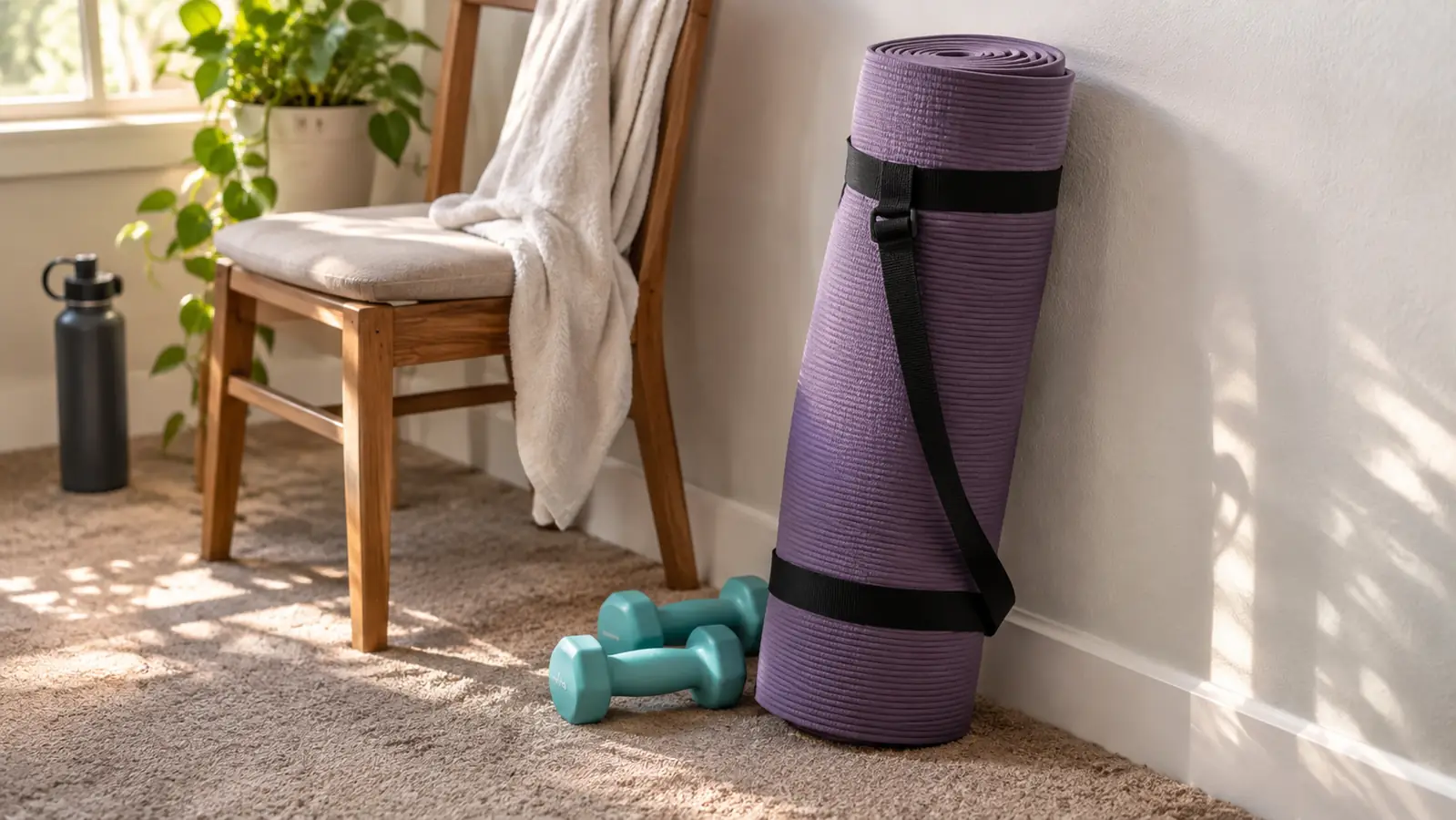
The first thing nobody tells you: the mat is heavy. The listing does not hide the weight, but you do not feel it until you try to carry it. Mine stays in the spare bedroom, so it is not a problem for me. If you plan to roll it up and move it from room to room, or take it to a class at the community center, think again. This is a mat that stays where you put it. That is a feature if you have a dedicated space, and a drawback if you do not.
It is also big. Rolled up, it stands about as tall as my hip, and it leans against the wall next to my dumbbells. If you have a small apartment, it will be a presence in the room. The strap helps you carry it, but it does not make it small. Measure your storage space before you order, not after. I made that mistake with a piece of equipment once, and it sat in the hallway for a week while I figured out where to put it.
The second thing nobody tells you: the surface is slick at first. The first week I used it, I had to be careful in socks. Barefoot was fine. The slickness wore off within a few weeks as the surface broke in. I mention it because a senior slipping on an exercise mat is exactly the kind of thing that would land me back in the doctor's office. Start barefoot or in grippy socks, and give the surface a few weeks to settle.
The third thing: it smells when it is new. Not terrible, but noticeable. I unrolled mine in the spare bedroom and left it for two days before using it. After about a week, the smell was gone. Carol noticed it more than I did. If you are sensitive to smells, unroll it somewhere with a window and give it time. It is not a reason to skip the mat, but it is a reason not to unbox it in a closed room and start using it that same day.
The Good: Where This Mat Earns Its Keep
For floor work, this mat is the best thing I have tried. My left knee has mild osteoarthritis, and kneeling on a thin mat or bare carpet used to mean a sore knee for the rest of the day. On the BalanceFrom mat, I can do a full set of hip and knee exercises and stand up without wincing. That is the whole point for me. The density is right: it cushions without collapsing. A cheap foam mat squishes down to nothing under my weight. This one holds up.
The anti-tear claim has held up too. I have dragged this mat across the carpet, knelt on it daily, and had Carol's sneakers on it. The surface shows some scuffs but no tears, no peeling, no places where the foam is separating. I expected it to last a year. It has already gone past that and looks like it has years left. For a piece of equipment that gets used daily, that is the kind of durability that matters more than any feature on a spec sheet.
The carrying strap is a small thing, but it is well made. The mat rolls up cleanly and the strap holds it tight. When I need to move it to vacuum under it, the strap makes it a one-handed job. The mat also stays put during exercise, which was my biggest worry before I bought it. On top of the rubber mat, it does not slide at all. Small details, but they matter when you use something daily and you are not as steady on your feet as you used to be.
The Tradeoffs: Softness, Balance, and the Carpet Question
Here is the honest tradeoff. A one-inch mat is wonderful under your knees and hips, but it is too soft for standing balance work. When I do single-leg stands or heel-to-toe walks, I do them on the rubber mat section of the floor, not on the BalanceFrom. The cushion that protects my knees makes the surface slightly unstable for balance exercises. That instability can be useful for your ankles, and some physical therapists recommend it, but if you are early in your balance work, you want a firmer surface. I learned this the hard way during the first month, when I tried to do my balance routine on the thick mat and found myself wobbling more than I should.
If you are choosing between a thick mat like this and a standard yoga mat, the short version is that they do different jobs. A standard yoga mat is thin, firm, and grippy, made for standing poses and balance. A one-inch mat is made for cushioning. I own both now. The BalanceFrom is for floor work. The thin mat is for standing work. If I could only keep one, it would be the BalanceFrom, because protecting my knees is the reason I train at all. But I would not want to be without the thin mat for balance days.
The carpet question: our spare bedroom is carpeted, and I put a rubber mat down under the exercise area. The BalanceFrom stays put on top of the rubber mat. On bare carpet, it shifts a little during exercises where you push off with your feet, like mountain climbers. If your floor is hard, the mat will not slide at all. If you are on carpet, a rubber mat underneath or a non-slip pad will save you frustration. This is one of those details that only shows up after you have used the mat for a few weeks.
How It Holds Up Over Time
A year and a half of daily use. Here is what I can tell you. The density has not changed. It still feels as firm and supportive as the day I unrolled it. The surface has scuffed where my sneakers push off, but the scuffs are cosmetic. No tears, no peeling, no flat spots. I have read reviews from people who say their mat developed indentations where they knelt. I have not seen that, and I kneel on mine every day.
Cleaning is simple: a damp cloth with a little dish soap, then let it air dry. I do that about once a month. The mat picks up dust and crumbs from the carpet, and the texture of the surface holds onto them, so a quick wipe is worth doing regularly. I also flip the mat over every few weeks so it wears evenly on both sides. That may not be necessary, but it costs me nothing and it seems to help.
The strap still works. The mat still rolls up tight. The smell is long gone. I have no complaints about durability, and I am a person who complains freely about things that do not hold up. If the mat had started to break down at any point in this year and a half, I would tell you. It has not.
A year and a half of daily use, and the mat still feels as firm as the day I unrolled it. No tears, no peeling, no flat spots.
What I Liked
- One inch of dense cushioning that protects knees and hips on carpeted floors
- Held up to daily use for over a year with no tears or peeling
- Carrying strap makes it easy to move when rolled up
- Easy to clean with a damp cloth
- Surface grips well barefoot after the first few weeks
Where It Falls Short
- Heavy and bulky; not a mat you want to carry from room to room
- Too soft for standing balance exercises
- Slick under socks when new
- Initial smell that takes about a week to fade
- Shifts on bare carpet without a pad underneath
Alternatives I Considered
Before I settled on the BalanceFrom, I tried two other options. The first was a thin yoga mat that I already owned. It worked for standing exercises, but it offered almost no cushioning for floor work. Kneeling on it over carpet was barely better than kneeling on the carpet itself. The second was a folding exercise mat, the kind sold for sit-ups and stretching. It was more padding than I needed, it was awkward to store, and the panels created a ridge in the middle that bothered my back.
I also looked at a standard yoga mat with extra thickness, the kind marketed for people with sensitive knees. It was thinner than this one, and the reviews suggested it would not hold up to daily use by someone my size. I am not a small man, and I need a mat that does not flatten out under me. The BalanceFrom was the right middle ground: more cushion than a yoga mat, less bulk than a folding mat. That is the honest reason I kept it.
Who This Is For
This mat is for anyone over 60 who does floor exercises and wants to protect their knees and hips. It is for the person whose doctor used the words 'leg strength' and 'independence' in the same sentence. It is for the person who has a spare corner rather than a full gym. If that sounds like you, the BalanceFrom will earn its place. It did in my house.
Who Should Skip It
Skip it if you want a mat for standing yoga or balance work. The cushion that protects your knees will work against you there. Skip it if you need something portable. This mat stays where you put it. And if you have serious balance concerns, talk to your doctor or physical therapist before you start any floor routine. I am not a doctor, and I do not pretend to be one. I am a retired mail carrier who did not want a fall on the ice to be the last word on my independence. This mat helped me do something about that. It might help you too, but start with your own doctor's advice.
Protect your knees and keep your independence
The BalanceFrom 1-inch mat is the one I kneel on every morning. If floor work is part of your plan, check today's price on Amazon and see if it fits your spare room.
Amazon Check Today's Price on Amazon →