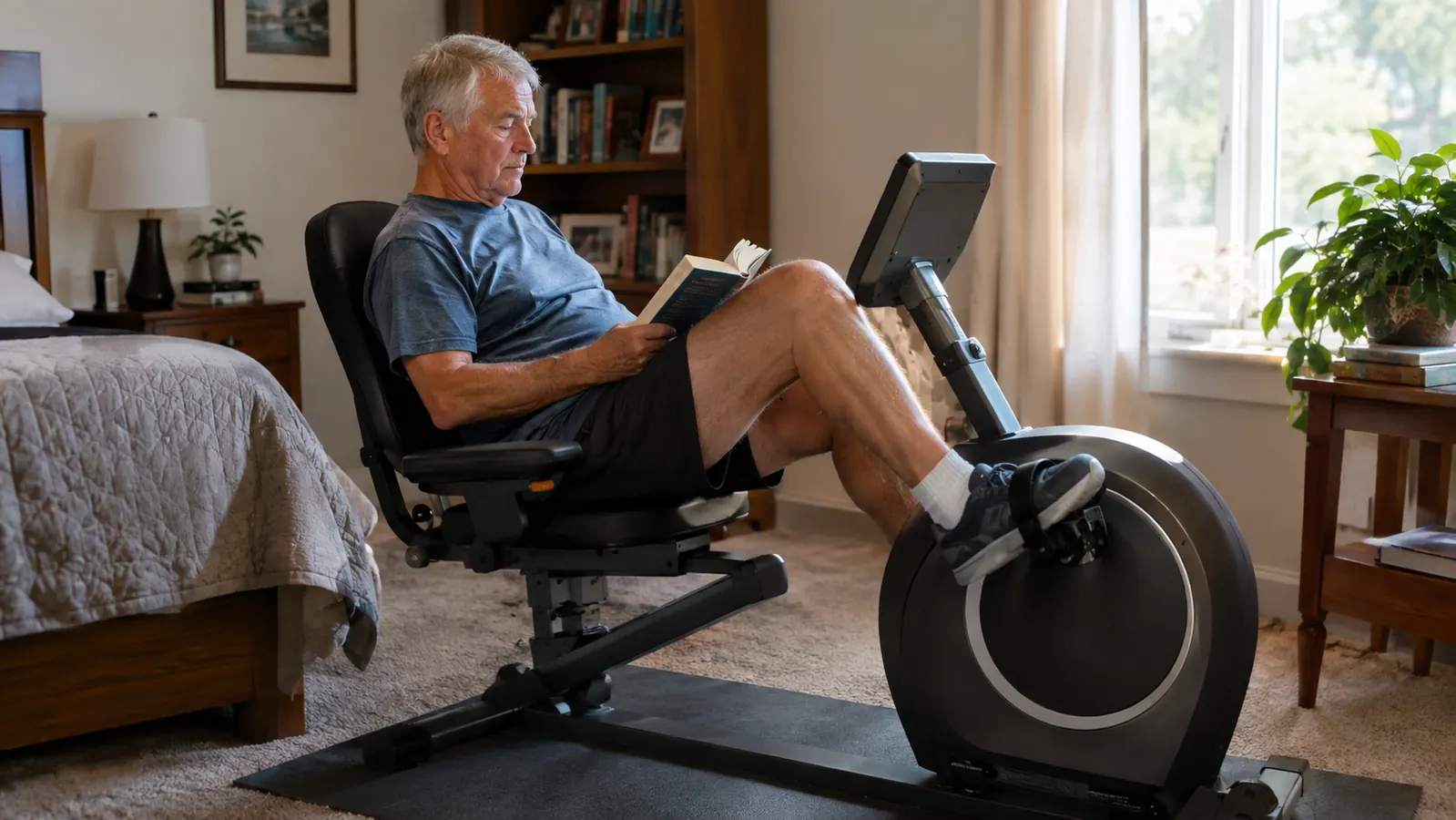
I bought my Sunny Health & Fitness recumbent bike about ten months ago, and I almost didn't. I'm Gene Holloway, I'm 69, a retired rural mail carrier, and I've been training in the spare bedroom of our house in Enid, Oklahoma for three years now, ever since my doctor told me that losing leg strength was the thing most likely to take my independence. I have a stiff left knee with mild osteoarthritis and a lower back that complains if I sit too long, so the idea of any bike made me nervous. What finally sold me was the position: sitting back against a real backrest, legs reaching forward instead of down, no weight on my wrists and no pressure on the knee at the bottom of the stroke. Ten months later, I think it was the right call. I also think the listing leaves out a few things you deserve to know before you hand over your money.
Here is the honest version, the part nobody puts in the product photos. It will not pedal itself. The seat is comfortable, but it is not magic. The console is basic, the app is optional, and the bike is heavy enough that you will not want to move it around every day. None of that stopped me from riding four or five mornings a week, and none of it should stop you if you know what you are getting. But I would have liked to know it before the box showed up, and that is exactly what this review is for.
The Quick Verdict
The right bike for a senior who needs to keep leg strength without punishing a stiff knee, as long as you know it is a tool, not a cure. I use mine four or five days a week, ten months in.
Amazon Check Today's Price →A recumbent bike that still gets ridden ten months later
The Sunny Health & Fitness Smart Recumbent Bike is the piece of gear I reach for most, and Carol uses it a couple of evenings a week. If you are weighing it against other options, today's price on Amazon is worth checking before you decide.
Amazon Check Today's Price on Amazon →How I've Used It
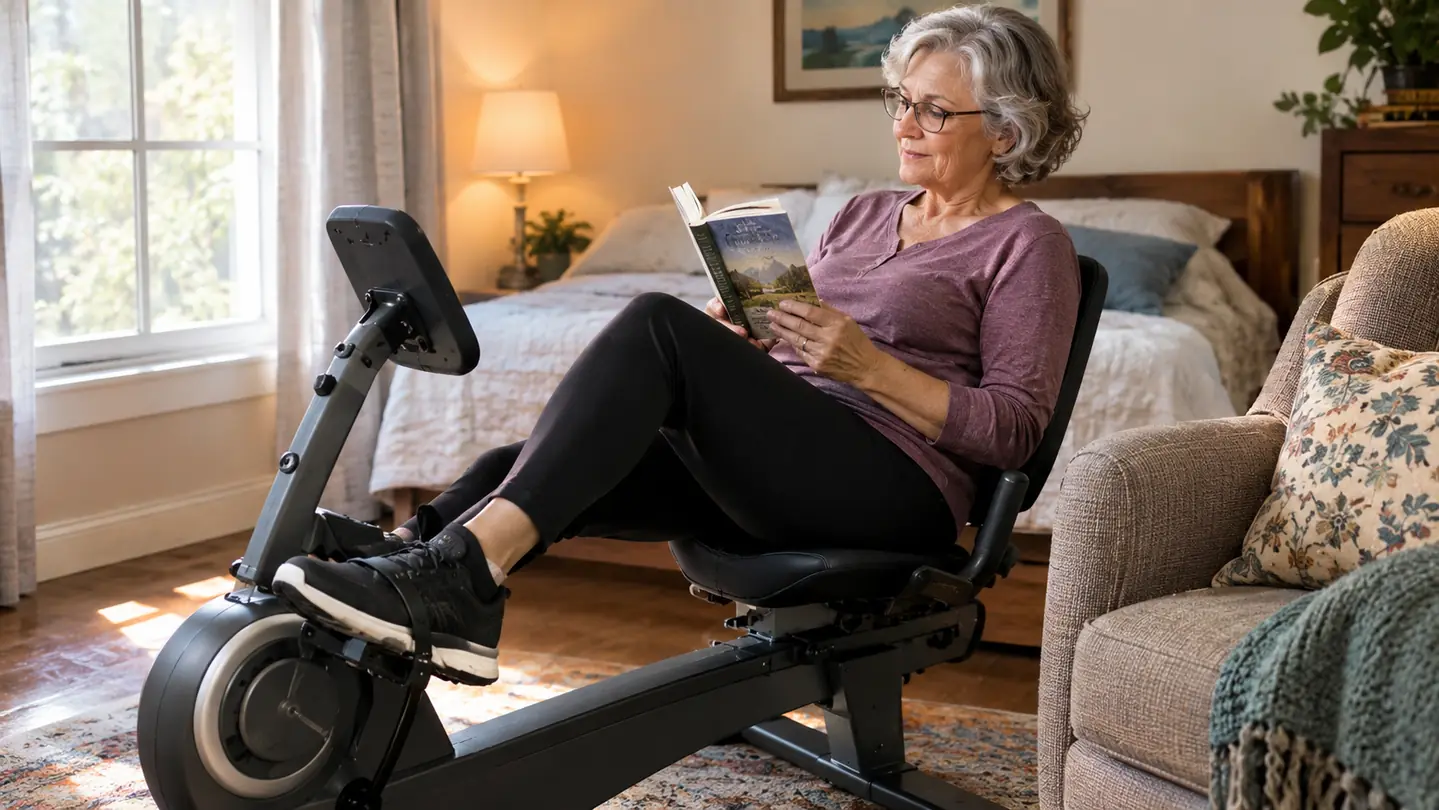
I ride four or five mornings a week, usually twenty-five to thirty-five minutes, and I read while I pedal. A paperback propped on my lap works fine because the backrest holds me upright and my hands are free. Carol, my wife, takes the bike over two or three evenings a week, often with a book in her hand too. That is the whole point of a recumbent bike for us: you can sit back, keep your knee at a comfortable angle, and still get your heart rate up without feeling like you are at a gym. It is exercise that fits into ordinary life, and at our age, that is what actually gets done.
The bike lives in the spare bedroom, about eleven by twelve feet, carpeted, with a rubber mat under it to protect the floor and keep it from sliding. The step-through frame means I do not swing a leg over anything. I just sit down, pull the pin, slide the seat, and go. At 69, that matters more than I expected it to. The wide cushioned seat and the backrest are not marketing fluff. They are the reason I can sit for half an hour without my back starting to talk, and the reason Carol does not mind taking her turn.
I started at the lowest resistance and stayed there for the first two weeks. Ten months in, I spend most rides on level three or four, with short stretches on five. That is plenty for me. If you are used to spin classes, this is not that, and it is not trying to be. It is a machine for steady, sustainable work, and that is exactly what my doctor ordered, in the literal sense. He did not tell me to buy this bike. He told me to move my legs against resistance most days, and this is how I do it.
What Nobody Tells You About the Seat
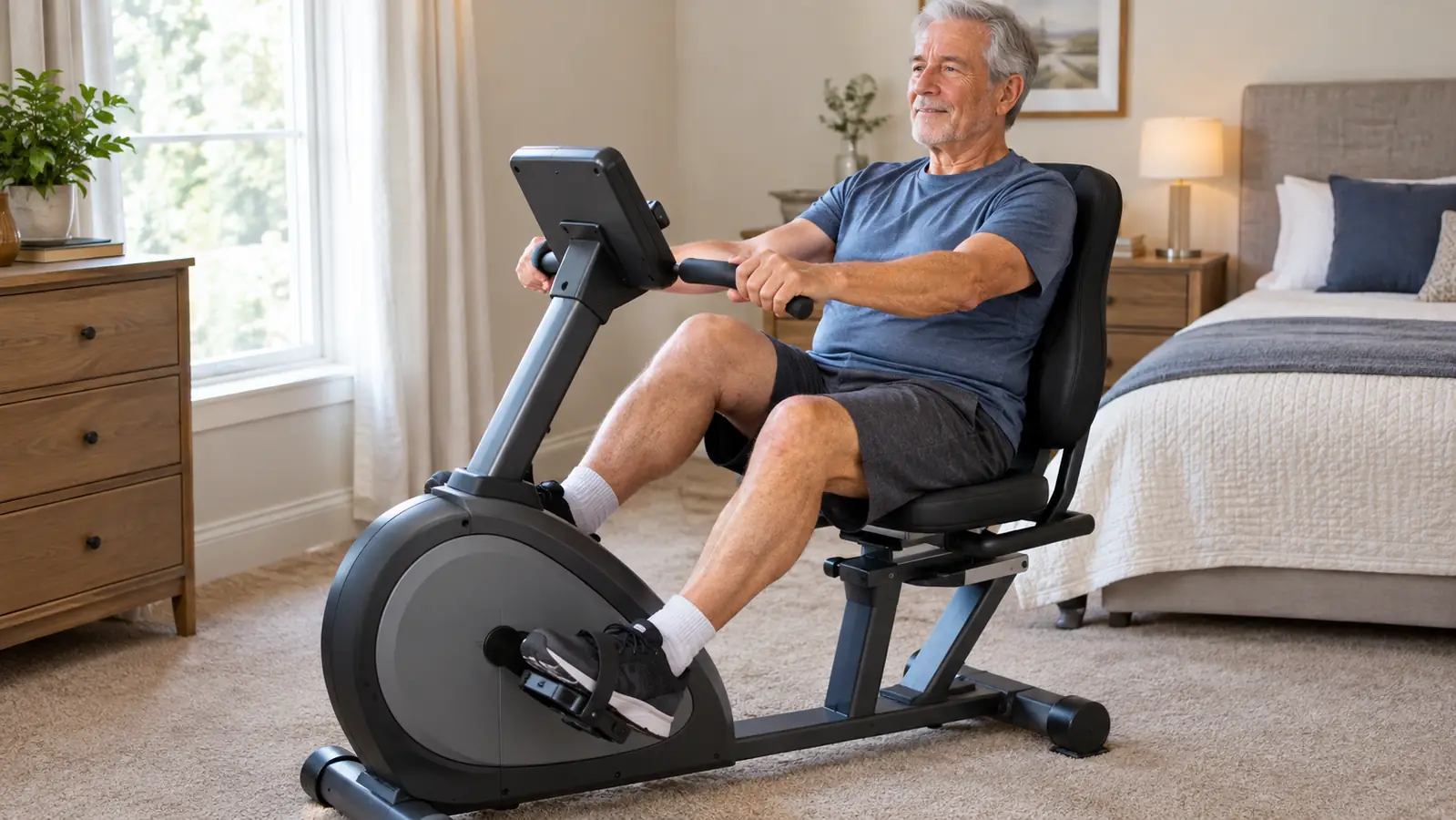
The listing says wide cushioned seat and back, and that is true. What nobody tells you is that the seat position matters more than the cushion. Slide the seat too far forward and your knee bends too sharply at the top of the stroke, and the old ache comes back. Slide it too far back and you are stretching for the pedals, which will make your lower back complain before you finish. I spent the first week adjusting a half inch at a time until my knee felt neutral through the whole pedal stroke. That adjustment is the difference between a comfortable ride and a reason to quit.
Once I found the right spot, I marked it with a strip of tape on the rail. Carol is shorter than I am, so she slides the seat forward when she rides and slides it back when she is done. The adjustment is a simple pull-pin deal, easy enough for either of us, but it is worth knowing you will be doing it if two people share the bike. It takes about ten seconds and it is not a problem. It is just a fact of sharing a machine, and I would rather know it going in than discover it the first time my wife asks me to move the seat.
The backrest is the part I underestimated. On an upright bike I would lean forward, and my lower back would start complaining by minute fifteen. Here I sit back, my spine stays supported, and I can read without bobbing my head around. For a man whose back complains when he sits too long, that is the difference between riding and quitting. I did not know I needed a backrest until I had one, and now I would not trade it. If you have any lower back trouble at all, do not let anyone talk you out of the recumbent position.
The Resistance Is Honest, Not Dramatic
The bike uses magnetic resistance with eight levels. The word 'smart' in the name is doing a lot of work, and I will get to that in a moment. The important part for a senior buyer is that the resistance is smooth. There is no friction pad, no jerking, and no dead spot that I can feel at the bottom of the stroke. Just a steady, even load that starts very easy and gets firm without ever getting brutal. That smoothness is what protects my knee, and it is the reason I can ride for half an hour without stopping.
Level one is genuinely easy, which is good for a bad knee day or a warm-up. Level eight is firm but manageable for me, and I am not a strong rider. If you are a younger, fitter person, you will outgrow this bike, and you should buy something with more range. I am not that person. I need resistance I can sustain for thirty minutes without my knee barking, and this gives me exactly that. There is real value in a machine that does not tempt you to overdo it.
The handlebar pulse sensors are accurate enough to show me I am in a sensible range, which is all I want at my age. If you need medical-grade heart rate data, you want a chest strap, not handlebar sensors. And if you are comparing this bike to a more expensive one, the resistance range is the main thing you are giving up. For most people over sixty, that trade is the right one. I would rather have eight smooth levels I actually use than twenty levels I am afraid to touch.
Assembly, Moving, and the Console
Assembly took me about an hour with a socket set, working alone, and nothing needed a second pair of hands. The Sunny Health & Fitness instructions are the usual folded-paper diagrams, and a couple of steps wanted more patience than clarity. It is not hard, but it is not a ten-minute job either. Plan an afternoon, lay the parts out on the rubber mat, and you will be fine. I would not want to do it on a hard floor, because a couple of pieces are awkward to hold while you bolt them together.
The bike is heavy. I do not have the shipping weight in front of me, but I can tell you I would not want to carry it up stairs by myself. It has small wheels on the front leg, so you can tip it and roll it across a flat floor, and the rubber mat makes that easy in our room. If your workout space is upstairs, or if you expect to move the bike between rooms often, factor that in before you buy. This is a machine that wants to find a home and stay there.
It is quiet. The magnetic resistance means no friction noise, and the only sound is a soft whir from the flywheel and the occasional creak from the seat rail if I forget to tighten it. Carol can read in the armchair beside me while I ride, and we can still hear each other talk. That is a bigger deal than the listing lets on. A loud machine in a small carpeted room would have driven both of us crazy by week two.
The console shows time, speed, distance, calories, and pulse, and it does that job fine. The buttons are big enough for my fingers, the display is easy to read from the seat, and it remembers my last session. That is all I ask of a console. The Sunny app is where the word 'smart' comes from. The bike can sync ride data to a phone app over Bluetooth, and the app will track your history and let you set goals. I use it now and then, but most days I just read the console. At 69, I do not need another dashboard in my life. But I can see the appeal for someone who likes seeing a streak, and it does not nag you if you ignore it.
What It Has Done for My Knee
I will say the part I am least comfortable saying: I am not a doctor, and this is not medical advice. What I can tell you is my own experience. The recumbent position keeps my knee at a gentler angle than an upright bike would, and the smooth pedal stroke means I am not hammering the joint the way I would on a hard outdoor ride. My physical therapist, who I saw for the knee before I started, agreed the position made sense for me. Talk to your own physician or therapist before you start anything new, and let them tell you what is right for your body.
Ten months in, the difference I notice is not on the bike. It is in the kitchen. I can stand up from a chair without using my hands, and I could not do that the winter before I started training. My balance on the porch steps is better, and that matters to me more than any number on a console. The bike is one of the reasons, along with the other work I do, and I would not want to give it up. Three winters ago I took a fall on an icy porch step, no broken bones, but it scared me straight about leg strength.
The knee is not cured. It still stiffens up in cold weather, and some mornings level one is all I have. But the bike has not made it worse, and it has given me a way to move my legs on days when a walk sounds like too much. That is what I needed it to do. I did not expect a cure, and I did not get one. I got a dependable machine that makes the work easy enough to keep doing, and for a man with a cranky knee, that is worth a lot.
One thing I will say plainly: this bike is not a substitute for walking, and I do both. The bike gives me steady resistance work for the legs and the heart, and the walks give me balance practice on real ground. They are different jobs, and I need both. If you are looking for a single machine to replace every other form of movement, this is not that machine, and I would be lying if I told you it was.
Ten months in, I can stand up from a kitchen chair without using my hands, and I could not do that the winter before I started.
What I Liked
- Step-through frame is easy to get on and off at 69
- Wide cushioned seat with a real backrest, comfortable for 30-minute rides
- Quiet enough to ride while my wife reads beside me
- Smooth magnetic resistance with eight levels, plenty for most seniors
- Ten-second seat adjustment works for two people of different heights
- Solid build, no wobble at the pedals after ten months
Where It Falls Short
- Heavy, and the small wheels are only for rolling on flat floors
- Assembly takes about an hour and the instructions are thin
- Console is basic, and the app adds little for me
- Level eight will not satisfy a serious cyclist
- Handlebar pulse sensors are approximate, not medical grade
Who This Is For
This is for the person my doctor was talking to. Someone past sixty who wants to keep leg strength without kneeling on a gym floor, without swinging a leg over a top tube, and without a trainer telling them to push harder. If you have a stiff knee, a complaining back, or just a spare bedroom and a New Year's intention, this bike meets you where you are. It is forgiving on the joints and honest about the effort. You still have to show up and pedal, but the machine removes every excuse I used to lean on.
It is also for households like ours, where two people of different sizes share one machine. The adjustment is quick, the seat is forgiving, and the learning curve is about ten minutes. Carol uses it a couple of evenings a week and has never once complained about the setup. When a piece of exercise equipment survives a year in our house without either of us finding reasons to skip it, that is the highest praise I know how to give.
One more thing I will tell any neighbor my age: buy it before the cold weather hits. In the winter, when the sidewalks are icy and the wind is cutting, having a bike in a warm room is the difference between training and not training. I fell on an icy porch step three winters ago, and that is part of why I set up this room in the first place. The bike does not care what the weather is doing outside.
Who Should Skip It
Skip it if you are a serious rider looking for a training tool. Eight levels of magnetic resistance top out well before a road cyclist's needs, and the basic console will frustrate anyone used to power data and structured workouts. Skip it if your workout space is upstairs and you are on your own, because moving this bike will be a two-person job. There are lighter folding options on the market, and they trade stability to get that weight down.
And be honest with yourself about one thing before you buy: no bike pedals itself. I have seen neighbors buy equipment, use it for two weeks, and hang a towel over it. The most comfortable seat in the world will not save you from that. If you are not ready to sit down and turn the pedals four days a week, start with a walk instead and come back to this when you are. The bike will still be here, and you will be in better shape to use it.
The bike I actually use, ten months later
The Sunny Health & Fitness Smart Recumbent Bike is not flashy and it will not do the work for you. What it does is make the work easy enough to keep doing, and that is the whole review. Check today's price on Amazon and see if it fits your room and your routine.
Amazon Check Today's Price on Amazon →