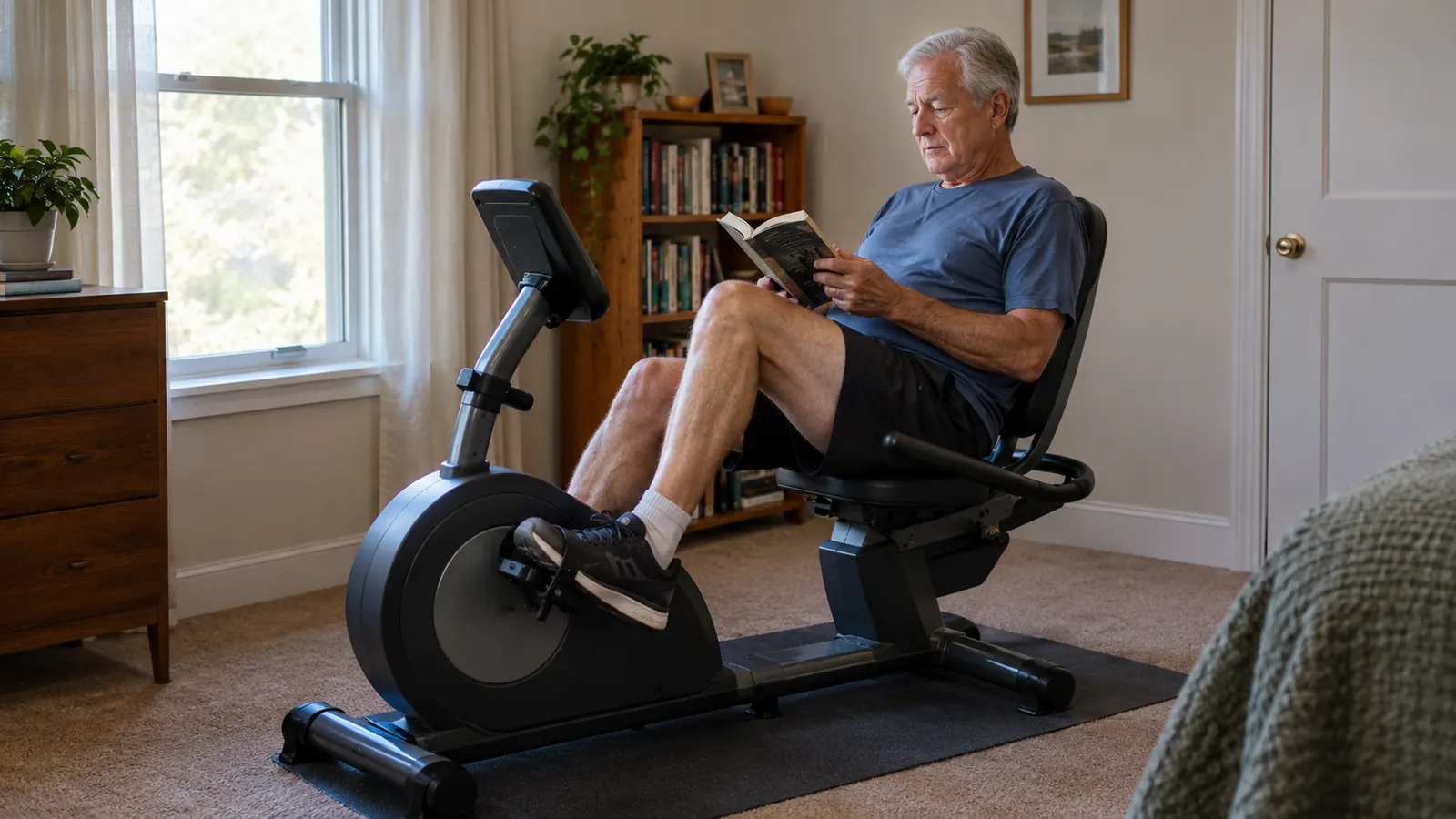
If you are trying to decide between a recumbent bike and an under-desk pedal exerciser, you are probably in the same spot I was three winters ago. My doctor told me that losing leg strength was the thing most likely to take my independence, and that was after a fall on an icy porch step scared me straight. I am Gene Holloway, 69, a retired rural mail carrier from Enid, Oklahoma, and I have been training in my spare bedroom for three years now. I tried both machines, and I can tell you plainly: they are not the same tool, and one of them did far more for me than the other. What follows is what I learned the slow way, so you do not have to.
The short answer is that a recumbent bike like the Sunny Health & Fitness Smart Recumbent Bike gives you a real seated workout with back support, adjustable resistance, and a position that is kind to a stiff knee. An under-desk pedal exerciser is a convenience gadget. It will keep your legs moving while you answer email, but it will not rebuild the strength you need to get out of a chair or catch yourself on a slick step. If you can spare a corner of a room and you want results you can feel, the recumbent bike wins. The pedal exerciser cost less and took up no space, which is why I bought it first. The bike cost more and needed a corner of a room, which is why I waited. Waiting was the mistake.
| Sunny Health & Fitness Recumbent Bike | Under-Desk Pedal Exerciser | |
|---|---|---|
| Real leg resistance | Eight levels of adjustable resistance that build strength over time | Light magnetic or strap resistance, mostly for movement, not strength |
| Back support | Wide cushioned seat with a full backrest, so your lower back can relax | You sit in your usual office chair, which is often the chair that already makes your back ache |
| Knee comfort | Reclined pedaling position keeps the knee angle open and comfortable | Knee angle depends entirely on your chair height, and most desk chairs put the knee too closed |
| Room to use it | Needs a corner of a room, about 4 by 2 feet of floor space | Fits under a desk and disappears when you are done |
| Can you read while using it | Yes, once you are used to the motion, a book or tablet sits fine on your lap | Yes, and that is its one real advantage, your hands stay free |
| Best for | Adults 60+ who want to rebuild leg strength and keep their independence | Office workers who want to fidget less and move a little more during the workday |
| Setup | Takes about an hour to assemble with basic tools, one-time job | Works out of the box, no assembly needed |
| Progress you can measure | Console tracks time, distance, speed, and heart rate, so you can see yourself improve | Most models have no readout, you just pedal until you are done |
Where the Sunny Health & Fitness Recumbent Bike Wins
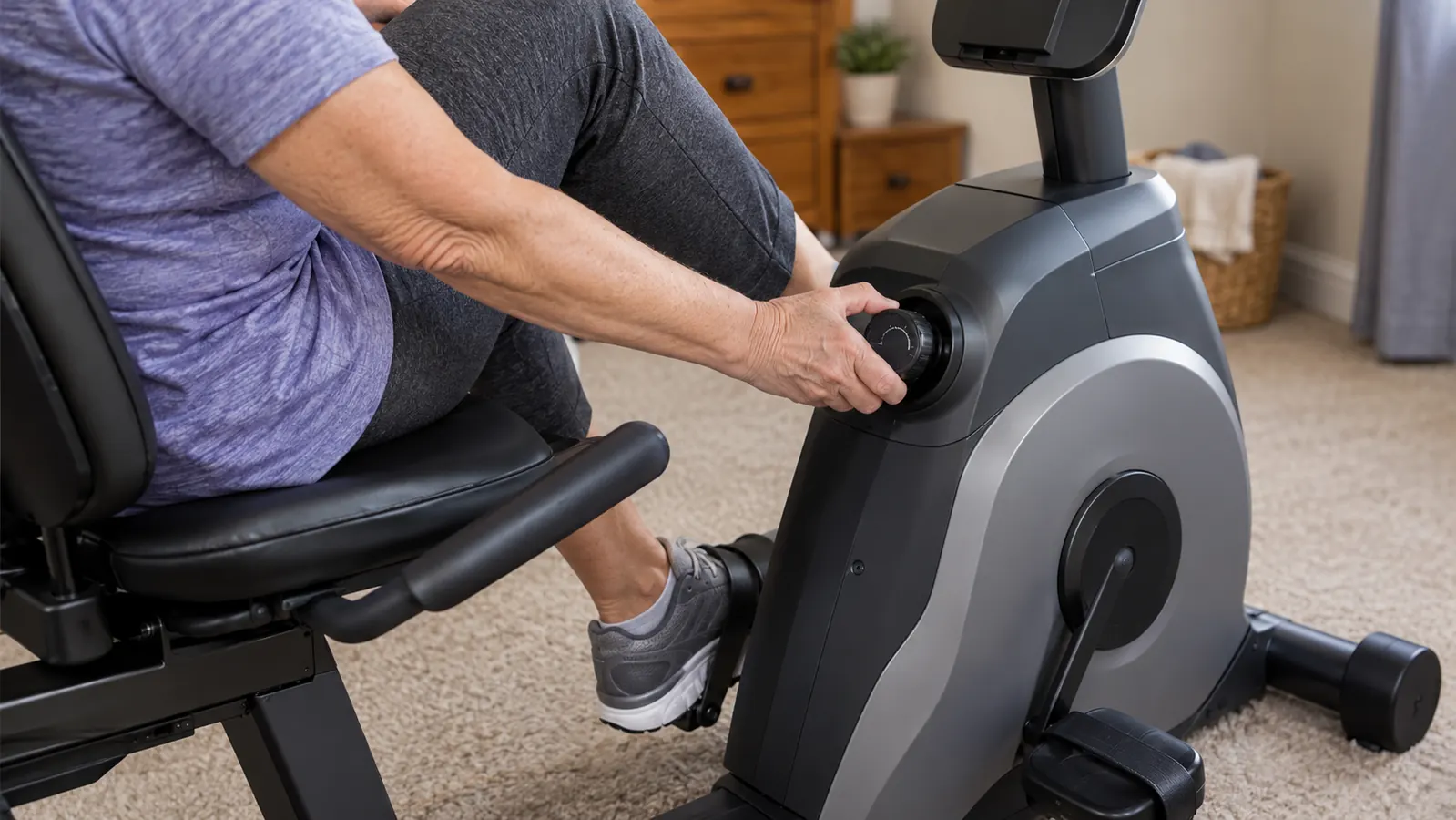
The biggest difference is resistance. The Sunny Health & Fitness Smart Recumbent Bike has eight levels, and level one is gentle enough for a bad day while level eight will make your thighs complain by the time you hit ten minutes. I started at level two for two weeks, moved to three, and by the end of the first few months I was doing thirty minutes at level five without stopping. These days I do thirty-five minutes at level six on a good day and level five on a day when my left knee is acting up. I keep a training log in a spiral notebook, the same kind I used for mail routes, and the dates do not lie: that first October was when thirty minutes at level five stopped feeling hard. You cannot do that on an under-desk pedal exerciser. Most of them offer light magnetic resistance that is fine for circulation but nowhere near enough to rebuild the muscle that gets you out of a low chair.
The second big win is the seat. The Sunny Health & Fitness bike has a wide cushioned seat with a full backrest, and that matters more than I expected. The seat is wide enough that my hips do not go numb on a thirty-five minute ride, and that matters at my age. My lower back complains if I sit too long, and on the recumbent bike I can relax into the backrest while my legs do the work. With an under-desk pedal exerciser, you sit in whatever chair you already have, and for most of us that is the same chair that makes our back ache by noon. My wife Carol tried both setups, and she put it well: on the bike, nothing hurts while you pedal. Under the desk, you are just adding movement to a position that was already the problem.
The third thing is the angle at your knee, and this one is personal for me. I have mild osteoarthritis in my left knee, and the position matters as much as the effort. On the recumbent bike, my legs reach out in front of me and the knee stays open, which is exactly what my physical therapist told me to look for. Under the desk, the angle depends entirely on your chair height, and most desk chairs put your knee too closed. After twenty minutes on the pedal exerciser, my left knee would start to complain. On the bike, I can do a full session and my knee feels better afterward than it did before I started. That is the difference between a machine built for a recovering body and a gadget built for a desk.
The last thing is the room itself. Our spare bedroom is about 11 by 12 feet, carpeted, with a rubber mat over part of the floor. The bike takes up a corner roughly 4 feet by 2 feet, and it sits on the mat so it does not creep across the carpet when I pedal hard. There is still room for Carol's yoga mat and the little television we watch while we train. The bike is quiet enough that Carol reads in the same room, and I do the same, a paperback propped on my lap. The console tracks time, distance, speed, and heart rate, and I will admit that watching the numbers creep up kept me honest in a way the pedal exerciser never could. Thirty-five minutes, five or six days a week, usually mid-morning. It has become as routine as coffee, and that routine is what actually changed my legs.
Where the Under-Desk Pedal Exerciser Wins
I will be fair to the little machine. The under-desk pedal exerciser wins on convenience, and convenience is not a small thing. It costs less, it takes up almost no space, it needs no assembly, and you can use it while you work, watch television, or talk on the phone. Plenty of people keep one under a desk and use it for twenty minutes most afternoons. They say it helps their legs feel less restless and keeps them from sitting completely still for hours. For that job, it is a fine tool, and I would not tell anyone to give it up.
I bought my pedal exerciser first, in the weeks right after the fall, because it was cheap and it fit under the desk in the spare bedroom. I used it while I paid bills and watched the evening news. For the first week it felt productive. By the third week I noticed I was spinning it faster without any more effort. I remember the exact day I gave up on it, a Tuesday in early spring, because I realized I had been pedaling for six weeks and the only thing that had changed was the speed of my feet. There was no way to add enough resistance to matter. I still have that pedal exerciser. It still sits under the desk in the corner of the bedroom, but I stopped pretending it was training.
It also wins if your goal is just to keep blood moving after surgery or during a long recovery. A physical therapist friend of mine told me that light pedaling under a desk is a reasonable way to get gentle motion without loading the joints. But notice the word gentle. That is the whole story. The under-desk pedal exerciser is a movement tool, not a strength tool. If you are hoping it will rebuild the leg strength that keeps you independent, it will let you down, and it let me down before I knew better.
There is one more thing the little machine does that the bike cannot match. It leaves your hands free. You can type, talk on the phone, read, or sit in on a video call while your legs move. The bike is a commitment: you sit down, you pedal, and for those thirty-five minutes that is what you are doing. The pedal exerciser asks nothing of your schedule. If you know you will never set aside a block of time for training, an under-desk pedal exerciser is better than nothing, and I mean that sincerely. Just do not expect it to do what a real bike does.
The under-desk pedal exerciser is a movement tool, not a strength tool. If you are hoping it will rebuild the leg strength that keeps you independent, it will let you down.
The recumbent bike that rebuilt my leg strength after 60
Wide cushioned seat, full backrest, eight resistance levels, and a quiet enough ride that Carol reads in the same room. This is the machine I wish I had bought three years ago instead of the pedal exerciser that sat under my desk. If your goal is staying independent, this is the tool that actually works.
Amazon Check Today's Price on Amazon →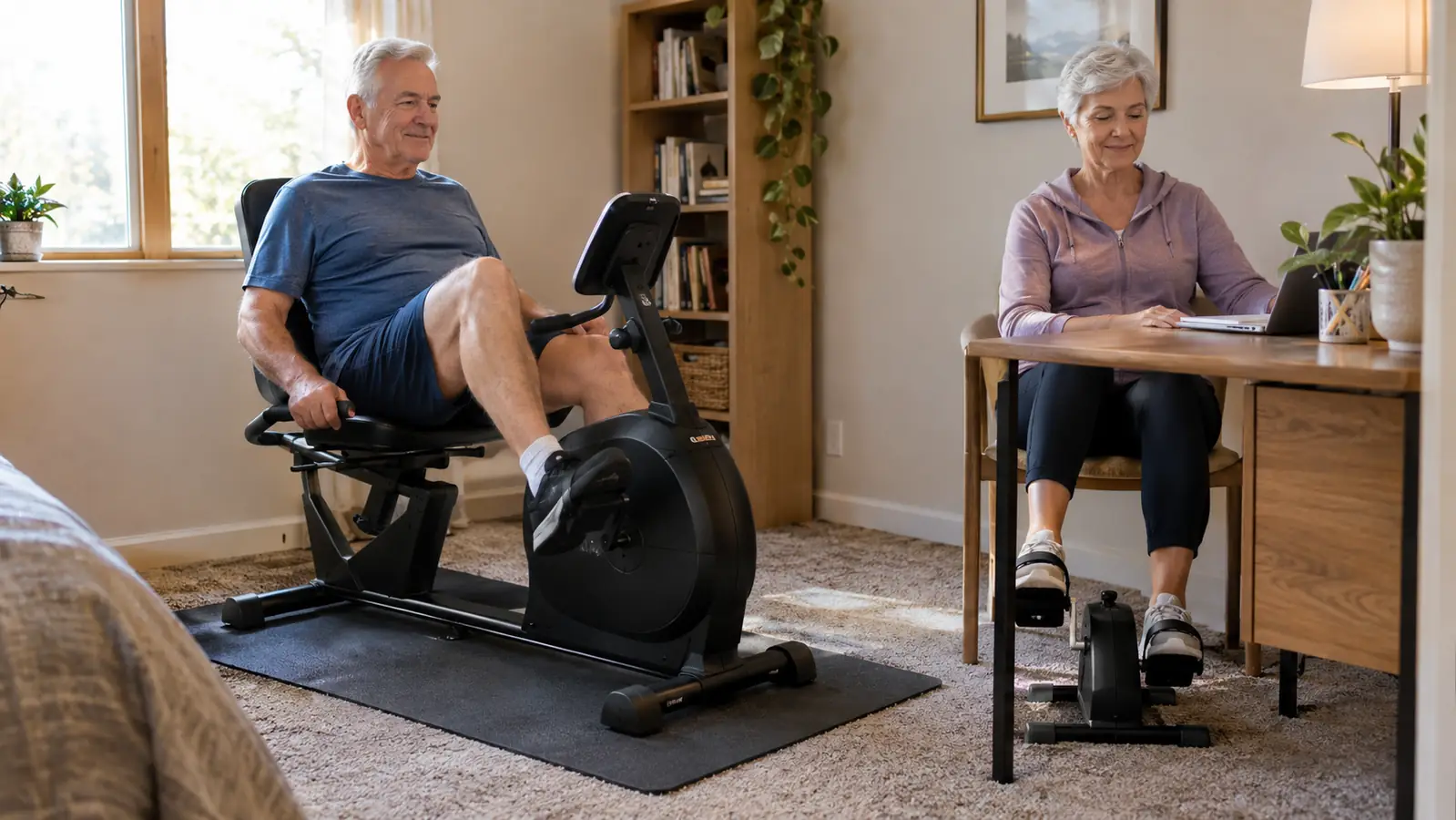
Who Should Buy Which
Buy the under-desk pedal exerciser if you sit at a desk all day, you are already reasonably strong, and you just want your legs to move more. Buy the Sunny Health & Fitness Smart Recumbent Bike if you are over sixty, you have felt your legs getting weaker, or a doctor has told you that strength training matters for your independence. That is the group I belong to, and that is the group the recumbent bike serves best.
Here is the test I would give anyone my age. Can you get out of a low chair without using your hands? Can you walk up a flight of stairs without holding the railing? When I was 66, the answer to both was no, and that was the honest reason I started. Now, at 69, I can do both. The pedal exerciser did not move those numbers at all. The recumbent bike did, slowly, over months, and the progress shows up in small moments: getting off the floor after kneeling to weed the flower bed, carrying both grocery bags in one trip, changing the spare tire on the car without asking the neighbor to help. My doctor was right about one thing: the muscles that lift you out of a chair are the same ones that catch you on uneven ground, and they only get stronger with load.
If you are not sure, do what I did: ask your doctor or a physical therapist before you buy anything. I am not a doctor, and I do not play one in this article. If you are sixty-five or older, check with your doctor before you start, especially if you have heart trouble or joint pain that is worse than mine. That is what I did, and it made the whole thing easier. What I can tell you is that the better part of a year of regular work on the Sunny Health & Fitness bike has made a measurable difference in my life. I get out of chairs more easily, I carry the groceries in one trip more often than not, and when I walk on ice now, I do not feel like one wrong step ends everything. That peace of mind is worth more than any machine, but the machine is what helped me earn it.
One honest warning before you order anything. The first month on the bike is boring, and my thighs were sore in a way they had not been in years, because they were finally doing real work again. I almost quit in week two. What saved me was cutting back to ten minutes a day until the soreness settled, then adding five minutes every week. Consistency beats intensity, especially at 69. The bike did not change my legs in a month. It changed them over months, and that is exactly what I needed it to do.
Start small: thirty minutes, three days a week
You do not need a garage gym or a trainer. You need a machine that supports your back, a corner of a room, and the willingness to start slow. The Sunny Health & Fitness Smart Recumbent Bike is the exact bike I have used for the better part of a year. Start with ten minutes at level two, like I did, and let the habit build itself.
Amazon Check Today's Price on Amazon →