Three winters ago I stepped on a patch of ice on my porch and went down hard. No broken bones, but it scared me worse than anything in my 31 years carrying mail. When I told my doctor about it at my next checkup, he said something I have not forgotten: the thing most likely to take my independence was not my heart or my blood pressure. It was losing leg strength and balance. That conversation is why a 69-year-old retired mail carrier has a small gym in the spare bedroom of his house in Enid, Oklahoma. And it is why, six months ago, I added a ProsourceFit balance pad to the floor of that gym.
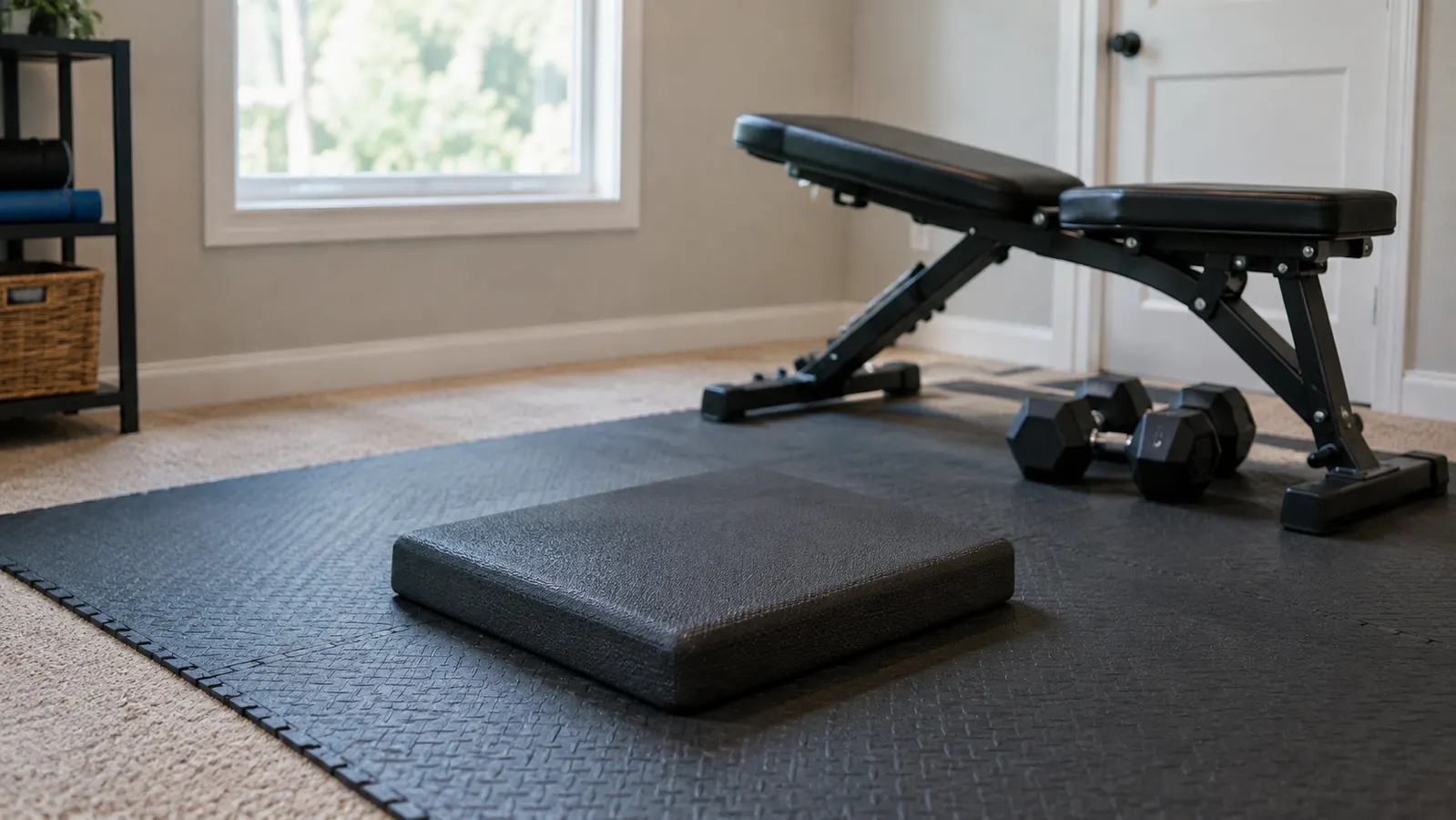
The pad itself is nothing special to look at. It is a flat slab of dense foam, roughly the size of a doormat, thick enough that you sink a little when you stand on it. The top surface is textured so your feet do not slide, and the bottom is textured too, so the pad does not slide on the floor. That is the whole product. No straps, no inflatable bladder, no app, no blinking lights. Just a firm piece of foam that makes your ankles, knees, and hips do small corrections all day while you stand there. My physical therapist suggested something like it after I mentioned that my left knee, which has mild osteoarthritis, felt unsteady on stairs. I read the reviews, picked the ProsourceFit, and started using it the day it arrived.
The Quick Verdict
Six months of daily use and this is the piece of gear I reach for most in my home gym. It is not flashy. It is a slab of foam that quietly makes your legs work harder. For an older adult who wants to improve balance at home, it is a sensible, affordable place to start.
Amazon Check Today's Price →The Simplest Thing in My Gym, and the One I Use Most
I have stood on this ProsourceFit pad every morning for six months. It does not look like much, but it has earned its spot on the floor. If you are considering balance work at home, check today's price on Amazon.
Amazon Check Today's Price on Amazon →How I've Used It
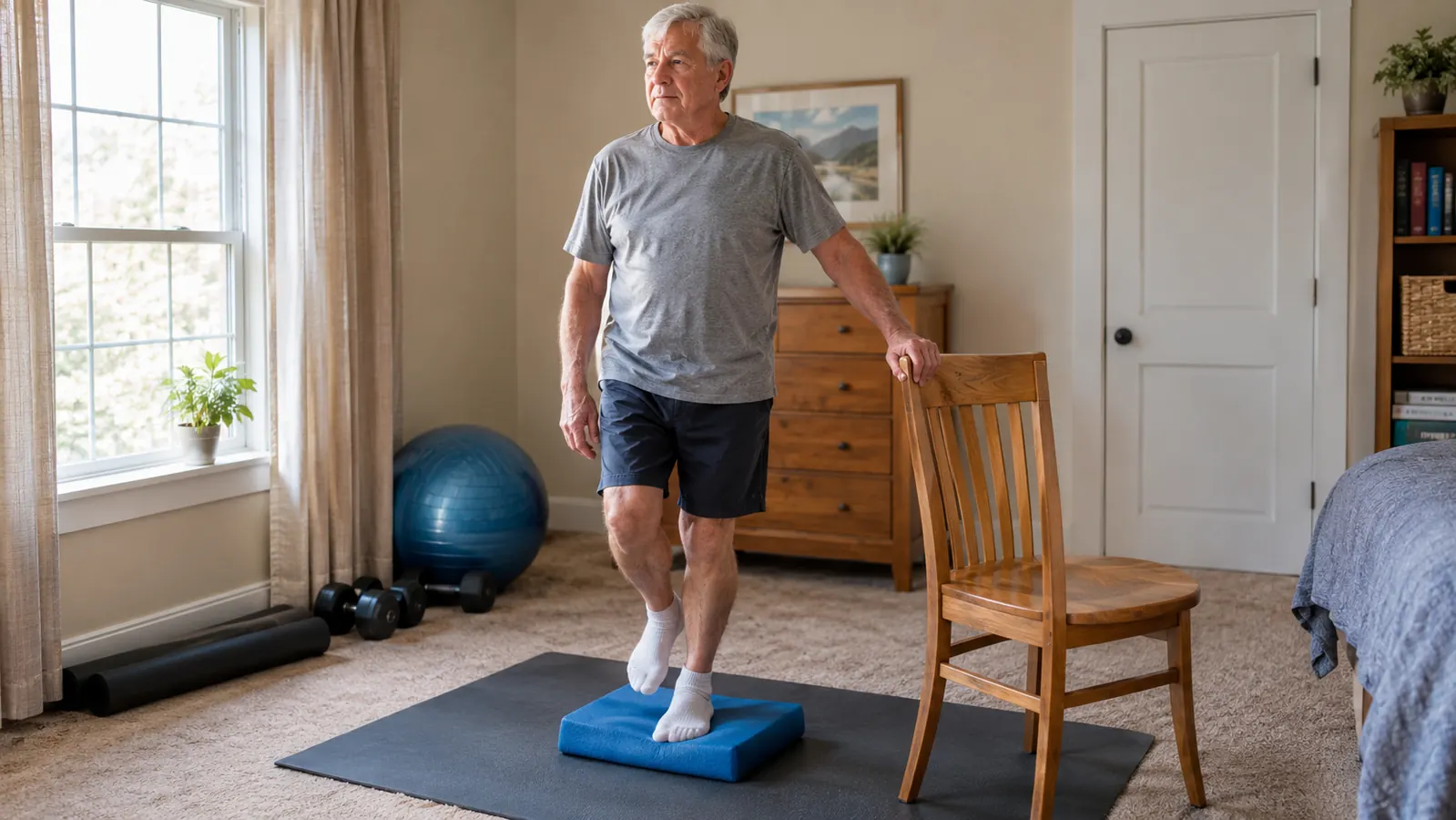
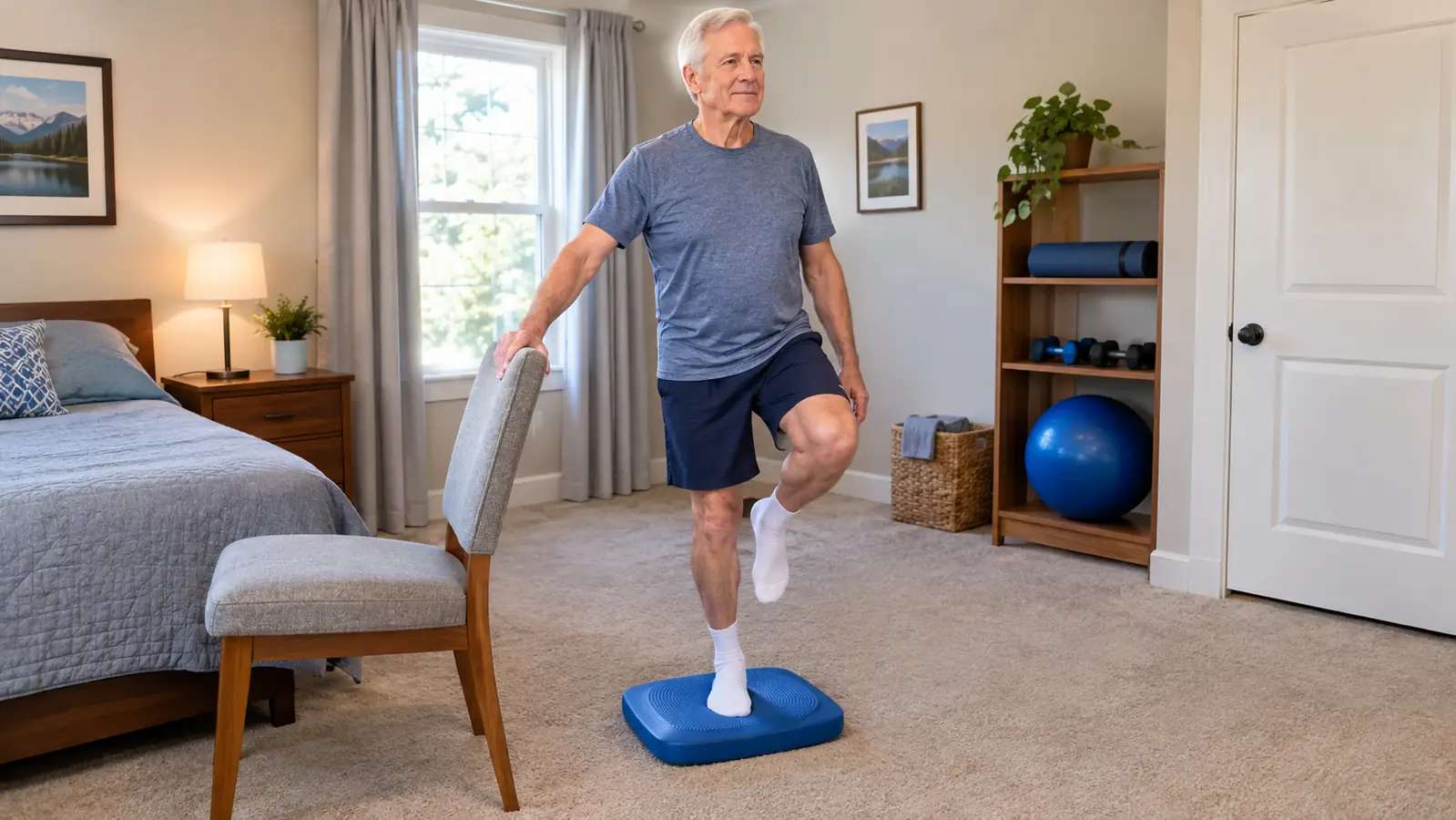
My routine is boring on purpose. Every morning after coffee I walk into the spare bedroom, kick off my slippers, and stand on the pad with both feet while I do my shoulder rolls and neck stretches. That first minute is just about letting my ankles wake up. Then I move to single-leg stands, thirty seconds on the right leg, thirty on the left, with one hand on the back of a chair when I need it. After that I do ten slow toe raises on the pad, then ten slow knee lifts. The whole thing takes about eight minutes. I do it before my strength work, which is mostly bodyweight squats, lunges, and dumbbell work with a pair of FEIERDUN dumbbells I bought around the same time. Some evenings I stand on it again while I watch the news, especially on days when I have sat too long. My lower back complains when I sit for hours, and twenty minutes of standing on the pad while half-watching television seems to help.
Carol, my wife, uses it too, a couple of times a week. She is 67 and does not have the knee problems I do, but she decided she wanted in after watching me for a month. She mostly does the two-foot stance and the toe raises, and she steals the pad for a knee pad when she does her floor stretches. The ProsourceFit listing calls it a balance pad and a knee pad, and that second use is real. I have knelt on it plenty of times when I stretch my lower back, and it is a lot kinder than the carpet.
One thing I will say plainly: I am not a doctor or a physical therapist. I am a retired mail carrier who got scared by a fall and did something about it. Before I started any of this, I cleared it with my doctor and spent a few sessions with a physical therapist, and I still do the exercises she gave me. The pad is an addition to that plan, not a replacement for it. If you are thinking about balance work, talk to your own doctor or physical therapist first. What worked for me might not be right for you.
Why a Flat Pad Works
The theory, as my physical therapist explained it, is simple. When you stand on a stable floor, your ankles do almost nothing. Your joints lock into place and your muscles relax. When you stand on something that gives a little, your body has to constantly make small corrections to keep you upright. Those corrections are tiny, but they are exactly the movements that keep you from falling when the ground is uneven or when you catch a toe on a curb. A balance pad does not make you stronger the way a squat does. It makes your legs quicker at catching you.
The ProsourceFit pad is firmer than I expected. I had imagined something squishy, like a thick yoga mat. It is not that. It is dense foam that gives maybe a quarter of an inch under my 190 pounds. That firmness is the right call, because a pad that squishes too much makes your ankles work too hard and can be uncomfortable for knees with arthritis. This one is forgiving enough to stand on barefoot for ten minutes and firm enough that the instability is useful, not annoying.
Six Months of Daily Use: What Actually Changed
The first week was humbling. I could stand on the pad with both feet fine, but the moment I lifted one foot I wobbled like a rookie on a balance beam. I kept one hand on the chair the whole time and still felt ridiculous. By week three I could do thirty seconds on each leg with just a fingertip on the chair. By week eight I could do the full thirty seconds on each side with no hands at all. That progress was faster than I expected, and it is the reason I kept going.
The bigger change was off the pad. Around month three I noticed that stairs felt different. My left knee, the one with osteoarthritis, had always made me hesitate on the way down. I would grip the railing and put my weight on the right leg. Somewhere around month three I realized I was taking stairs normally, not thinking about it. I am not going to claim the pad fixed my knee, because it did not. The knee still aches on cold damp days. But my leg does not feel as tentative, and that is a real, noticeable difference.
After six months of daily use, the pad itself still looks good. There is a slight compression where I stand, a shallow dent you can see if you look closely, but the foam rebounds when I am off it and the textured surface has not worn smooth. I have not noticed any tearing or peeling. I do not baby it. It lives on the rubber mat in the corner of the room and I step on it every single morning. For a piece of foam that costs what this costs, that is the durability I hoped for.
What surprised me most is that I never dreaded it. I have owned exercise equipment that I avoided because it was a production to use. The pad is the opposite. It is right there on the floor, it takes eight minutes, and there is no setup or cleanup. The days I skip my strength work are usually days when my back is complaining, but I have missed the pad maybe five times in six months. That consistency is the real reason it worked.
Tradeoffs Worth Knowing About
The biggest tradeoff is that this pad is gentle, and gentle is not what everyone wants. If you are looking for serious instability training, the kind that makes your ankles burn after two minutes, a wobble board or an inflatable disc will give you more. I tried a friend's wobble board once and it was too much for my knee. The ProsourceFit pad is a middle ground. It challenges you just enough to be useful, but it will never punish you. For a 69-year-old with a stiff knee, that is exactly what I want. For a 30-year-old athlete, it would be boring.
The other tradeoff is that the pad does not come with any guidance. You get the pad and a box. There is no booklet of exercises, no suggested routine, no app. If you already know what to do with a balance pad, that is fine. If you do not, you are on your own. I only knew what to do because my physical therapist showed me. If you buy this without a plan, I would start with the two-foot stance and single-leg stands, and I would check with a professional before doing anything more advanced.
What I Liked
- Simple enough that I actually use it every day, which matters more than any feature
- Dense foam gives just enough instability to work your ankles and knees without punishing them
- Textured top and bottom mean it stays put on carpet, rubber mat, or bare floor
- Doubles as a knee pad for floor stretches, and it is genuinely good at that
- Light, quiet, and easy to move out of the way when Carol wants the room for her mat
- Six months of daily use and the foam still holds its shape
Where It Falls Short
- No guidance included; you have to know what to do or get help from a professional
- Gentler than a wobble board or inflatable disc, so it will not satisfy someone who wants aggressive instability work
- The foam compresses slightly where I stand, and I expect to replace it eventually, just not yet
- It is a tool, not a program; if you do not use it, it will not help you
I went from gripping the chair with both hands to standing on one leg for thirty seconds, and that happened in about eight weeks.
Alternatives I Considered
I looked at three other options before settling on the ProsourceFit. The first was a wobble board, a round wooden platform on a ball. I tried a friend's once and my knee complained for two days. Too much rotation for a joint with arthritis. The second was an inflatable balance disc, which is basically a round air cushion. It offers more instability than a flat pad and takes up about the same floor space, but it needs inflating and it can slowly leak. I did not want to fuss with that. The third was a Bosu ball, the half-sphere with a flat platform. It is a fine piece of equipment, but it is big and I did not have room in my spare bedroom gym for another large thing.
There is also the free option, which is doing the same exercises on the floor. I did that for my first two and a half years of training, and it is genuinely better than nothing. But the pad adds something the floor cannot: a small, constant need to correct yourself. The floor gives you nothing to correct against. The pad gives you just enough. That is the whole argument for spending money on a piece of foam, and after six months I think it is a fair argument.
Who This Is For
Buy this pad if you are an older adult who wants to work on balance at home and you are looking for something simple, forgiving, and hard to mess up. Buy it if your doctor or physical therapist has told you to do balance work and you want a tool that makes those exercises more effective. Buy it if you have had a fall or a near fall and you want to do something about it before it happens again. Buy it if you want a piece of equipment that does not require assembly, instructions, or motivation beyond stepping on it for eight minutes a day.
It is also a good fit if you spend a lot of time sitting, because your balance is one of the first things to slide when you sit all day. I spent 31 years on my feet carrying mail, and even so I noticed my balance getting worse in the years after I retired. A few minutes on the pad each morning is a small, specific answer to a problem that creeps up slowly.
It is also worth saying that the pad works for people who are not seniors. Carol uses it, and a couple of friends my age have tried it when they came over. The point is not your age. The point is that balance is one of those things that quietly declines if you do not use it, and a pad is a low-friction way to use it.
Who Should Skip It
Skip it if you have an acute injury, a recent surgery, or a balance disorder that your doctor is already managing. A foam pad is not therapy, and it is not a substitute for supervised rehabilitation. Skip it if you want a serious challenge; go with a wobble board or an inflatable disc instead. And skip it if you are the kind of person who buys equipment and lets it gather dust, because this pad only works if you stand on it. It will not help you from the corner of the room.
I will also say this: if you are over 60 and you have not talked to your doctor about falls, do that before you buy anything. The conversation is uncomfortable and quick. My doctor told me the truth, which is that a bad fall at my age can change everything. The pad is one small part of how I answered that. Strength training with my dumbbells, the recumbent bike Carol and I both use, and the exercises my physical therapist gave me all matter just as much. The pad is not the whole answer. It is a good piece of the answer, and six months in, I am glad I bought it.
Six Months In, I Still Step On It Every Morning
The ProsourceFit balance pad is the least impressive-looking thing in my home gym, and it is the thing I use most. If you are thinking about balance work at home, this is a reasonable place to start. Check today's price on Amazon and see if it fits your routine.
Amazon Check Today's Price on Amazon →