The morning my doctor told me to start lifting weights, I was sixty-six years old and thought he meant someone else. I had carried mail for thirty-one years, and my legs had always done what I asked. The only things that hurt were my left knee and my lower back after long drives. Then I took a fall on an icy porch step that same winter. No broken bones, but it scared me. My doctor said losing leg strength was the thing most likely to take my independence, and I believed him.
I started in our spare bedroom with bodyweight moves and a rack of fixed garage-sale dumbbells. That worked, up to a point. But as I got stronger, I needed heavier weight, and a rack of fixed dumbbells does not fit in an eleven by twelve foot carpeted room. Six months ago I switched to a FEIERDUN adjustable dumbbell set, and it changed how I train without changing where I train. The dials let me change from ten pounds to twenty-five pounds in seconds, and the whole set lives in a corner of the room. This is the plan I have followed since, written down for anyone who wants the same thing.
One set of dumbbells that grows with you
The FEIERDUN adjustable set takes up about as much floor space as a pair of shoes, but it covers the weights I needed at the start and the weights I use now. Talk to your doctor, then check today's price on Amazon.
Amazon Check Today's Price on Amazon →Step 1: Start With a Goblet Squat for Your Legs
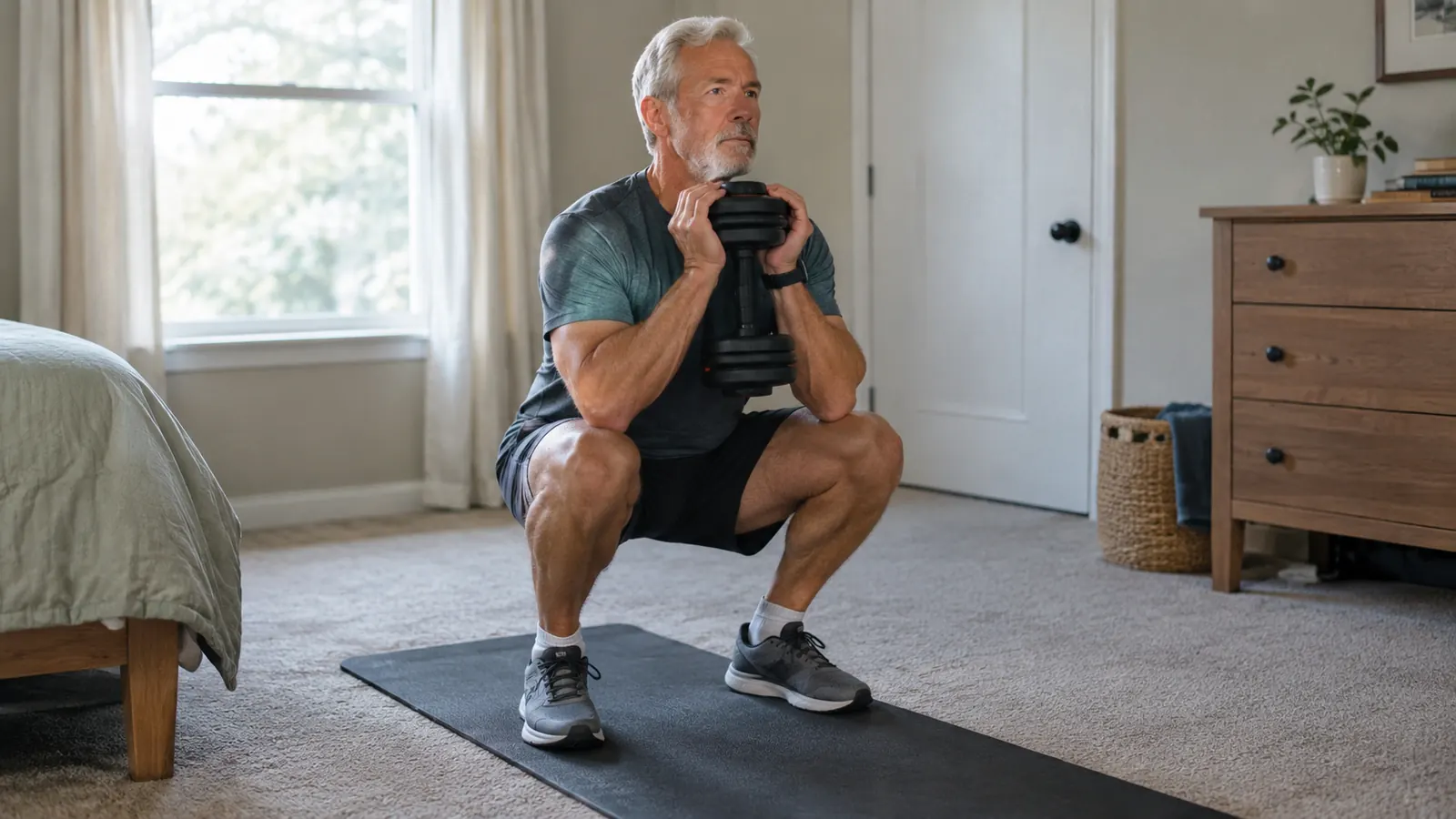
The first move I added was the goblet squat. You hold one dumbbell vertically against your chest with both hands, plant your feet a little wider than your hips, and sit down like you are reaching for a low chair. I kept my heels down and my chest up, and I held the dumbbell close so it did not pull me forward. I started with a weight I could handle for ten clean reps. For me that was twenty pounds, because my left knee complained when I pushed too fast.
I did three sets of ten, twice a week, for the first month. The rule I used was simple: if I could not finish the last two reps with good form, the weight was too heavy. When ten reps started to feel easy, I moved up five pounds. With the FEIERDUN set, that change took about thirty seconds instead of a trip to a sporting goods store.
The reason this move matters is not the weight. It is the way it trains you to stand up from a low chair, get out of a car, and step up onto a curb. Those are the movements that keep a person independent. I still do the goblet squat every week, and my left knee handles it better now than it did six months ago.
Step 2: Build Arm Strength With a Seated Shoulder Press
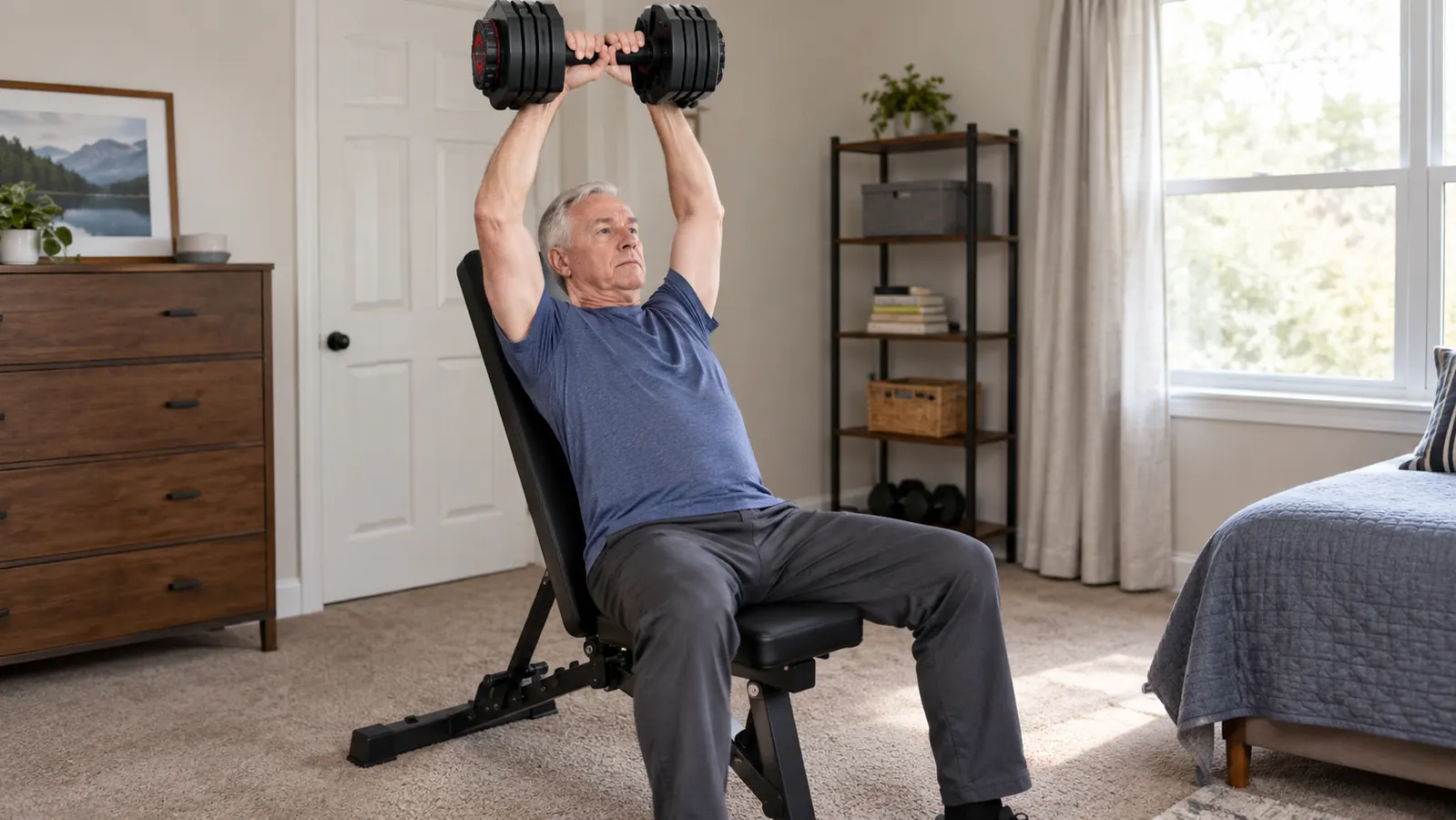
For my arms and shoulders, the seated dumbbell press became my anchor. I set the folding bench to an upright position, pressed both dumbbells from shoulder height to straight overhead, and lowered them slowly. I pressed up and let the dumbbells meet lightly at the top, then lowered until my elbows were just below my shoulders. I started lighter than I wanted to, because my shoulders had spent decades sorting mail, not lifting weights.
Three sets of eight, twice a week. I went from ten pounds to fifteen pounds to twenty pounds over about three months. My wife Carol noticed before I did. She said my shirts fit differently across the shoulders, and that was the first time I believed the work was showing.
Arm strength shows up in ordinary places. Carrying a full grocery bag, lifting a suitcase into the trunk, opening a stuck window, all of those got easier. I do not train my arms to look a certain way. I train them so daily life stops feeling like a test.
Step 3: Add a Romanian Deadlift for the Back of Your Legs
The move that helped my lower back the most was the Romanian deadlift. You hold one dumbbell in each hand, hinge at the hips, and lower the weights along your thighs until you feel a stretch in your hamstrings, then stand up. I kept my back flat and let the weights hang close to my legs, because letting them drift forward turns the move into a back strain. It is not a squat and it is not a bend. It is a hinge, and it took me a few sessions to get the feel.
I kept the weight modest and the reps higher, three sets of twelve. The first time I did these, my hamstrings were sore for two days. That told me I had found a muscle I had not been using. After a month, the ache in my lower back after long car rides got quieter.
Form matters more here than anywhere else. I started with no weight at all, just my body, and practiced in front of a mirror until the movement looked right. When I added dumbbells, I added ten pounds per hand and stayed there for a month. If you have back trouble, check with your doctor or a physical therapist before you try this one.
Step 4: Train Your Arms With a Curl and a Tricep Extension
For the front of the arm, I do a standing bicep curl with both dumbbells. I keep my elbows close to my sides and curl slowly, then lower just as slowly. I curled both arms at the same time, because alternating felt harder to keep steady. For the back of the arm, I do an overhead tricep extension with one dumbbell held in both hands. I kept both moves to two days a week and never chased a heavy number.
The FEIERDUN connector bar, which joins the two dumbbells into one long bar, made the tricep extension feel more stable. I also used it for a light bent-over row. Small changes like that kept the routine interesting enough to stick with for six months, and sticking with it is what built the strength.
A note on arms: they recover fast, but they do not need much to grow stronger. Two focused sessions a week was plenty for me. I did curls and extensions after my leg work, when my arms were fresh but my legs were already tired. That order kept me honest about using light enough weight.
Step 5: Finish Every Session With a Farmer's Carry
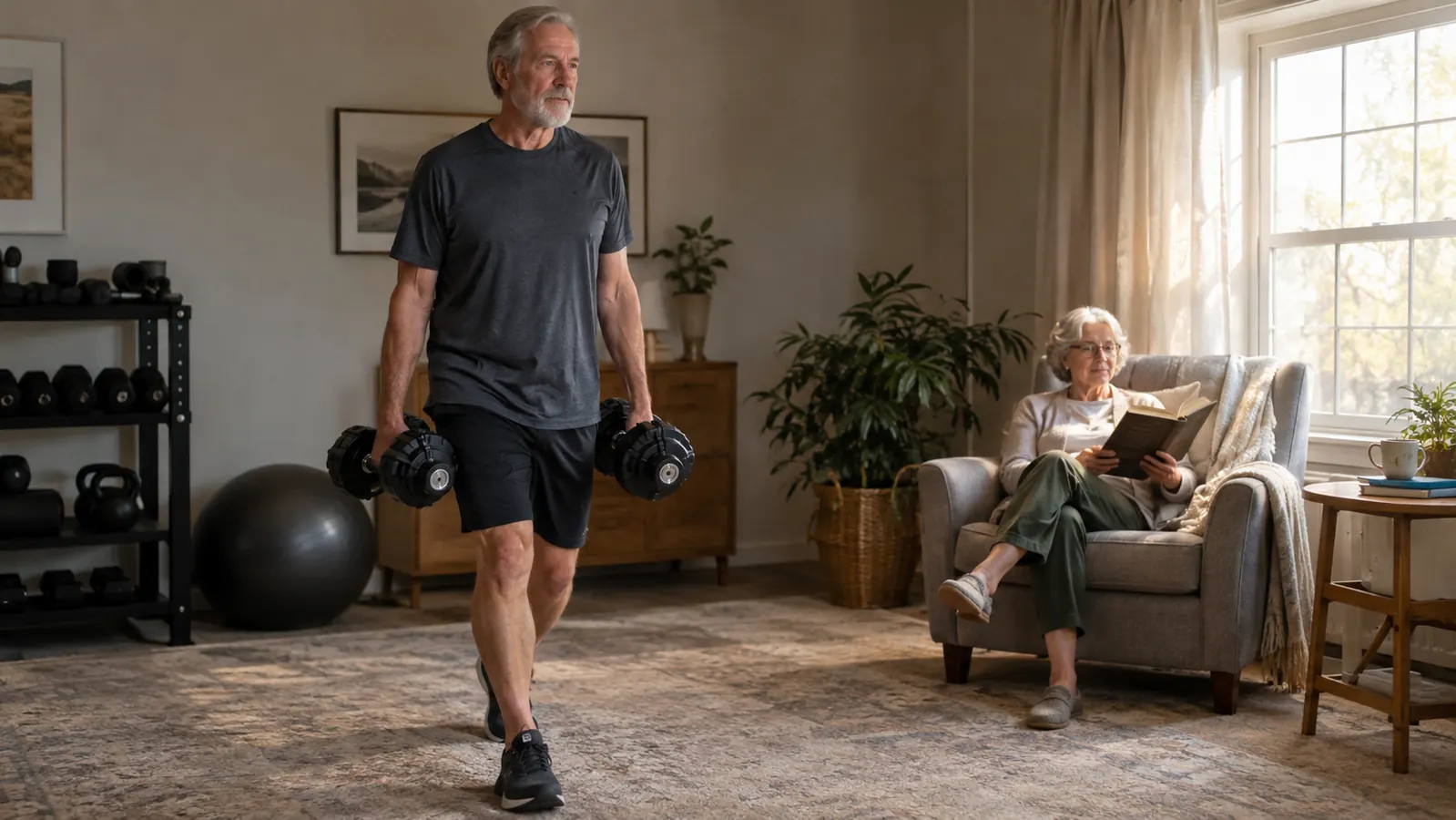
The last thing I do is a farmer's carry. I pick up a dumbbell in each hand, stand tall, and walk the length of the spare bedroom and back, ten or twelve steps. I looked straight ahead, not down at my feet, and took short steps. It sounds too simple to matter, but it works your grip, your core, your legs, and your balance all at once.
I started with twenty pounds in each hand and worked up to thirty. The carry is the closest thing I have to a test of whether I am ready for daily life, because carrying groceries or a mail satchel uses the same muscles. Six months in, I can carry two full grocery bags up the porch steps without holding the railing.
Balance is the part I care about most, because a fall is what started all of this. The farmer's carry forces me to walk tall while carrying something, which is exactly what I do on a bad sidewalk or a wet porch. I do it last, when I am tired, because that is when balance matters most in real life.
How I Structure the Week
I train three days a week, usually Monday, Wednesday, and Friday. Each session takes about forty-five minutes, including the warm-up. I do the goblet squat first because it is the move that matters most for my independence. Then I move to the shoulder press, then the Romanian deadlift, then the arm work, and I finish with the farmer's carry. That order keeps the big leg movements early, when I have the most energy.
Rest days are part of the plan, not a sign of weakness. On Tuesday and Thursday I ride the recumbent bike for twenty minutes while Carol reads in the chair beside me. I also do a few balance pad sessions during the week, usually while I am waiting for coffee to brew. The dumbbell work stays at three days, and my knee and back have done better with that schedule than they did when I tried to do more.
I keep a small notebook on the bench. Each session I write the date, the weights, and how the knee felt. That sounds like something a coach would make you do, but it takes two minutes and it tells me when to move up. If a weight felt easy for two sessions in a row, I add five pounds the next time. If the knee complained, I stayed put. The notebook keeps me honest.
What I Learned in Six Months
The biggest surprise was how much my everyday life changed. Carrying mail was my old job, but these days the test is carrying a water softener salt bag from the trunk to the garage. I do that without thinking now. The second surprise was that my knee got quieter, not louder, once I started squatting with light weight. My doctor had warned me to be careful, and I was, but the movement itself seemed to help.
I also learned that motivation is overrated. There are plenty of mornings I do not feel like training. I do it anyway, because I made a rule that I can always do a shorter session, but I cannot skip it entirely. Showing up for twenty minutes on a bad day is better than waiting for a good day that may not come. That rule has carried me through six months, and it will carry me through the next six.
What Else Helps
The dumbbells did the heavy lifting, but they were not the whole story. I warm up with five minutes on our recumbent bike or a slow walk around the room. The bike gets my knees moving without impact, which helps on cold mornings. I do a few minutes on a balance pad before I start, because balance was the thing that scared me most after the fall. I also use a set of light resistance bands on off days.
I put a rubber mat under the bench so the carpet does not shift, and I keep the dumbbells in the corner where I can see them. Out of sight means out of mind, so I leave them where I will trip over them if I skip a session. None of that is fancy. It just makes it easier to show up three days a week, and showing up is the real program. Start lighter than you think you need, rest between sessions, and let the weight go up slowly.
I also learned to listen to my body without turning every ache into a reason to stop. Soreness after a new move is normal. Sharp pain is not. When something hurt sharp, I backed off the weight or skipped that move for a week. That distinction kept me training steadily instead of quitting after the first bad day.
Six months in, I can carry two full grocery bags up the porch steps without holding the railing.
The set that fits in a spare room and grows with you
If you are sixty or older and training at home, the FEIERDUN adjustable dumbbells are the piece of equipment I would buy first. Talk to your doctor, start lighter than you think you need, and check today's price on Amazon.
Amazon Check Today's Price on Amazon →